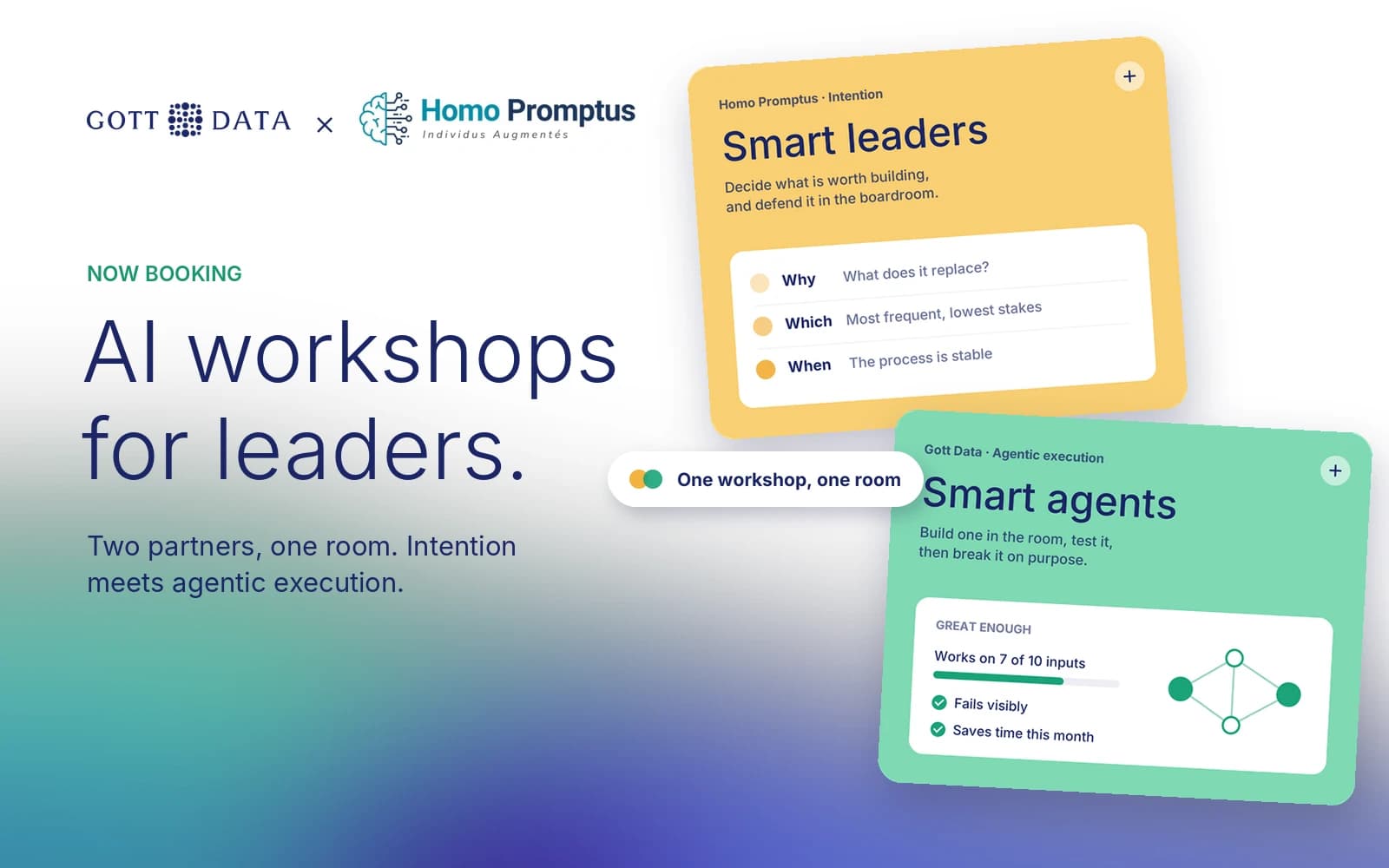
Gott Data and Homo Promptus are partnering to run agentic AI workshops where leadership teams build their first AI agent. In one session, executives decide which agents are worth building, build one, and test it on their own work. Every workshop ends with something working, not just something learned.
Why workshops, and why now?
Most leadership teams have sat through enough AI explainers. They know the vocabulary. What they lack is a way to decide what to build, defend that decision in a board meeting, and know when it has gone wrong.
A workshop gets there faster than a three-month project. It puts the people with budget authority in one room, working on their own problems. If a longer engagement follows, it follows from what the team discovered in the room.
Each workshop starts with a short survey and a conversation with the team's leader. So the day is built around the questions that organisation is actually asking.
Why Gott Data and Homo Promptus together?
Over the last few years, we kept meeting the same problem from two sides. Homo Promptus worked with leadership teams on how they think about AI: where human judgement belongs, and what an augmented organisation looks like. Gott Data built the data foundations and AI systems that have to run every day, cost what they should, and be checked.
We saw the same gap again and again. Leaders who understood AI still didn't know what to build. Teams who could build still didn't know what was worth building. One answer doesn't work without the other.
This workshop is where that work comes together. Henri and Desh designed it as one method, and deliver it together, in the room from the first minute to the last. The thinking and the building happen in the same session, on the same problem, so leaders never have to translate between strategy and execution.
What is the agentic execution workshop?
It is our newest format, designed for executives with budget authority and no technical background. Groups are small, six to twelve people. Everyone leaves with one working agent and a one-page brief they can hand to their team the next morning.
We open with a question we deliberately leave unresolved: are agents good, bad or ugly? Everyone else sells a verdict. We think the honest answer is case by case, so we give leaders a way to judge each case.
Before anything gets built, every idea passes three gates:
- Safety. Can it hurt us? First agents read, they do not write. They draft, they do not send.
- Cost. Can we afford to run it, and to maintain it? The running cost is usually small. The hidden cost is someone's attention, forever.
- Verifiability. Can a non-expert tell when it is wrong, in under two minutes? If not, it should not be built, however attractive it looks.
Then the build. Each participant brings one recurring task they do themselves and resent. They test it against the gates, write the procedure in plain language, build the agent, and try it on a real input. Then they break it on purpose, to see how it fails.
The lesson most leaders take home has little to do with technology. If you cannot write the procedure down for a person, you cannot write it for an agent. The bottleneck is rarely the tool. It is that nobody ever wrote down how the work gets done.
We also run a live exercise on tokens, the pieces of text AI models read and charge for. Leaders see what their everyday prompts cost per year, and which habits cut that cost without losing quality.
What does "great enough" mean?
Nobody leaves feeling their agent failed. An agent is great enough if:
- It works on about seven out of ten realistic inputs.
- When it fails, it fails visibly, not plausibly.
- It saves more time this month than it took to build.
- Its owner can explain it in one sentence without saying "AI".
Anything beyond that is optimisation. The point of the bar is permission to stop.
How can my team book a workshop?
We are now taking bookings from leadership teams across Europe, in English and other languages. If your organisation is weighing where AI agents belong, and where they don't, tell us about it. We read every message and reply personally.