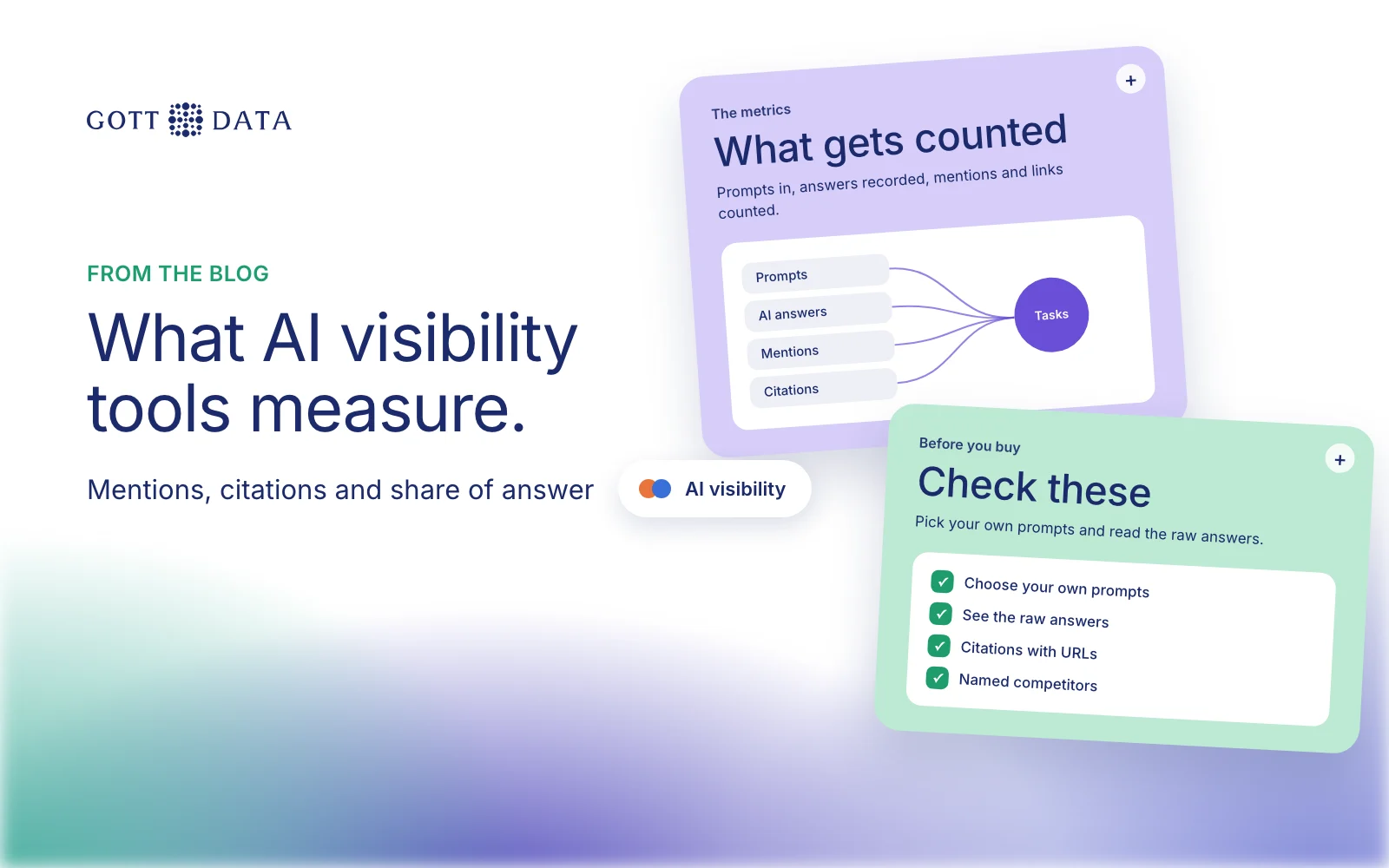
AI visibility tools show whether assistants such as ChatGPT, Gemini and Perplexity mention your company when people ask them for advice. They put a fixed list of questions to those assistants on a schedule, record the answers, and count who gets named and which pages get cited. The numbers are useful, but only if you know what each one means and how it was measured. Here is what to look for, and how to do the same job by hand.
What do AI visibility tools measure?
Most tools report some mix of these:
- Prompts tracked. The questions the tool asks, such as "best hotel in Akureyri for families". Everything else depends on this list.
- Mention rate. The share of answers that name your brand at all.
- Share of answer. Your mentions against competitors' mentions across the same prompts. It's the AI version of share of voice.
- Citations. Which web pages the assistant links to or credits, and whether any of them are yours.
- Position and framing. Are you the first suggestion or the fifth, and is the description accurate?
- Trend. How each of these moves week by week.
Citations are often the most useful line. They show which outside pages shape the answer: a directory, a review site, a competitor's blog. Those are the places to work on.
Why are the numbers so noisy?
Assistants don't give the same answer twice. Wording, location, sign-in state and the model version all change the result. A single run tells you little.
Good tools deal with this openly. They repeat each prompt, report how many runs sit behind a figure, and show the raw answers so you can read them. Be wary of a single "AI visibility score" with no way to see what produced it.
How should you evaluate one?
Ask these questions before you pay for anything:
- Can you choose the prompts? Generic prompts measure a generic market. You want the questions your customers actually type, in their language.
- Which assistants does it cover? ChatGPT, Gemini, Perplexity and Google's AI answers behave differently. Check the list matches where your buyers ask.
- Can you see the raw answers? If you can't read what the assistant said, you can't judge the metric.
- How often does it run, and how many times per prompt? Weekly with repeats beats daily with one shot.
- Does it show citations with URLs? Without them you know you're missing, but not why.
- Does it compare you with named competitors? Share of answer only makes sense against a set you chose.
- Does it tell you what to do next? A list of gaps turned into tasks is worth more than another chart.
Free tiers are fine for a first look. Just check how many prompts they allow, because a handful of questions can't tell you much.
How do you track AI visibility by hand?
You don't need a tool to start. A spreadsheet and an hour a week will do:
- Write 20 to 30 questions your customers ask before they buy. Mix broad ones ("best data consultancy in Iceland") with specific ones ("Power BI help for a small hotel group").
- Pick three to five competitors to track.
- Each week, ask every question in each assistant you care about. Use a logged-out or clean session where you can.
- For each answer, record: were you mentioned, in what position, which competitors appeared, and which links were cited.
- After a month, sort the cited pages by how often they appear. That's your list of sites to be listed on, reviewed by or written about.
The limit of doing it by hand is time. Thirty prompts across four assistants is 120 answers a week, and the manual work tends to stop after a few weeks.
How does this connect to SEO?
Closely. Google says there are no extra technical requirements or special markup needed to appear in its AI Overviews and AI Mode: pages need to be indexed and eligible for a snippet. OpenAI says sites that block its OAI-SearchBot crawler won't be shown in ChatGPT search answers. So the basics still decide whether you can appear: crawlable pages, clear text, good internal links.
AI visibility tools add the measurement on top. SEO tells you where you rank for a keyword. AI visibility tells you if the answer names you.
Where does Growth HQ fit?
Our Growth HQ is one option. It asks your customers' questions across several AI assistants every week, shows who gets recommended and who gets cited, and turns the gaps into tasks. It sits next to SEO rankings, Google Ads and sales reporting, all in one workspace. You can try the demo to see the reports before deciding.