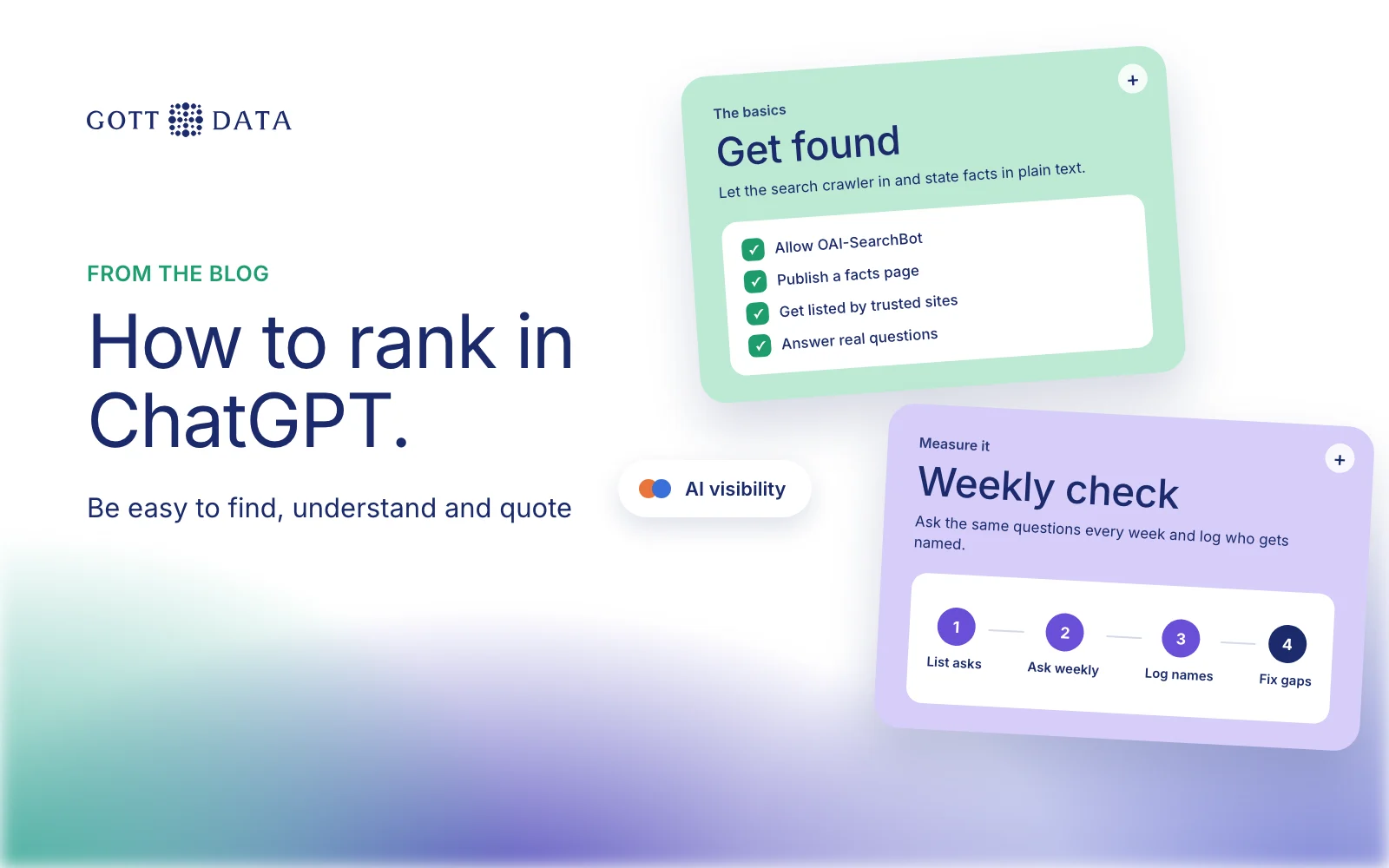
How to rank in ChatGPT, in short: be easy to find, easy to understand and easy to quote. ChatGPT's search features surface websites found by OpenAI's own crawler. Its answers lean on companies that clear, trusted pages describe well. No one controls what it says, and anyone who promises a top spot is guessing. You can still raise the odds, and you can measure whether it's working.
How does ChatGPT decide which companies to mention?
There are two routes into an answer. The first is what the model learned in training. The second is live search: ChatGPT looks up pages on the web and builds its answer from them, often with links back.
You can't change training data quickly, but you can shape the second route. Answers tend to draw on pages that state facts plainly, match the question asked, and come from sources the wider web already trusts. Treat it like search, because that is partly what it is.
Can ChatGPT find your site at all?
Start with the technical basics. OpenAI uses a crawler called OAI-SearchBot to surface websites in ChatGPT's search features. Its documentation says sites that block OAI-SearchBot will not be shown in ChatGPT search answers, though they may still appear as navigational links.
Check three things:
- robots.txt allows OAI-SearchBot. Blocking GPTBot is a separate choice: that crawler is for model training, not search.
- Your CDN or firewall isn't blocking bots by default. Some security settings do this without telling you.
- Key facts are in text, rather than locked in images, PDFs or scripts that load late.
OpenAI notes that a robots.txt change can take about 24 hours to take effect.
What should your own site say?
AI assistants are good at picking up clear, specific statements and poor at guessing. So say what you do in plain words:
- A facts page. One page with who you are, where you operate, what you sell, who it's for, and what it costs, if you publish prices.
- One page per service or product. Name the thing the way customers search for it, such as "data warehouse consulting in Iceland", not a clever brand phrase.
- Answers to real questions. Short FAQ sections that answer "how much", "how long" and "which is better for" questions directly.
- Proof you can link to. Case studies with the client, the problem and what changed.
Structured data such as schema.org markup is fine to add, but don't expect miracles from it. Google, for example, says no special markup is needed to appear in its AI features. Clear visible text matters more.
Why do other sites matter more than yours?
When someone asks "what is the best tour operator in Reykjavík", an assistant often leans on lists, reviews and directories rather than the operator's own site. Being described by others is the strongest signal you can earn.
Work on the places that already rank for your questions:
- Directories and review sites in your industry, with complete and current profiles.
- Comparison and "best of" articles. Ask to be included, and give the author the facts they need.
- Partners and clients who can mention you on their own pages.
- Local press and trade bodies, which carry weight for local questions.
Consistency helps. If your name, location and services read the same way everywhere, an assistant has less to reconcile.
How do you rank higher in ChatGPT search results?
There is no ranking position to chase in the way there is on Google. A few habits still help:
- Write for the question, not the keyword. "Which BI tool suits a 50-person company?" deserves a page that answers exactly that.
- Keep pages current. Dates, prices and team details that are out of date get quoted anyway.
- Be specific. Numbers, places and names are easier to cite than adjectives.
- Stay out of thin content. A hundred near-identical pages add noise, not visibility.
How do you know if it's working?
Measure it, because answers change from week to week. Make a list of 20 to 50 questions your customers actually ask. Put them to ChatGPT and other assistants on a schedule, and record three things each time: whether you are mentioned, which competitors are, and which pages are cited.
Over a few months you'll see which questions you win, which you lose, and which sources keep coming up. Those sources are your to-do list.
You can do this by hand in a spreadsheet. Our Growth HQ runs the same questions across several AI assistants every week, shows who gets recommended and cited, and turns the gaps into tasks. Either way, the goal is the same: know where you stand before you start changing things.