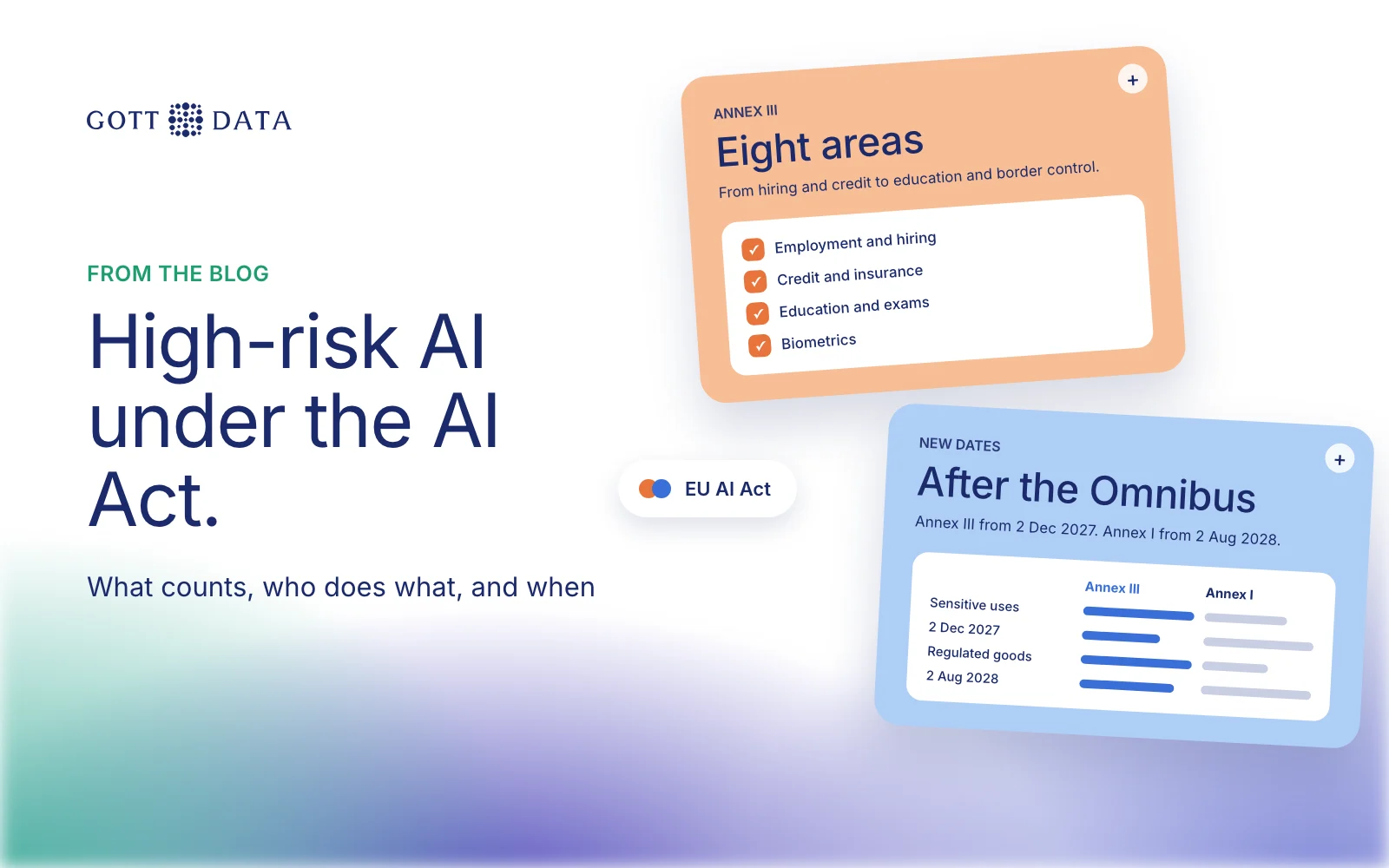
Under the EU AI Act, high-risk AI systems fall into two groups. The first is AI used in eight sensitive areas listed in Annex III, such as hiring, credit scoring and education. The second is AI that acts as a safety component in products already covered by EU safety law, listed in Annex I, such as machinery, lifts or toys. After the AI Omnibus, the Annex III rules apply from 2 December 2027 and the Annex I rules from 2 August 2028. This post explains what counts, what the obligations are, and what to do now. It is a plain summary, not legal advice.
What counts as a high-risk AI system?
Article 6 of the Act sets two routes.
Route 1: products under Annex I. An AI system is high-risk if it is a safety component of a product, or is itself a product, covered by the EU laws listed in Annex I, and that product needs a third-party conformity assessment. The Commission gives robot-assisted surgery as an example. AI used only for things like user help or performance tuning, with no effect on safety, is excluded.
Route 2: uses listed in Annex III. Annex III names eight areas:
- Biometrics, where permitted by law, such as remote identification and emotion recognition.
- Critical infrastructure, such as safety components in road traffic or in water, gas, heating and electricity supply.
- Education and training, such as deciding admission or grading learning outcomes.
- Employment, such as screening job applicants or monitoring worker performance.
- Essential private and public services, such as credit scoring, life and health insurance pricing, and triaging emergency calls.
- Law enforcement, such as assessing how reliable evidence is.
- Migration, asylum and border control, such as supporting visa or asylum decisions.
- Justice and democratic processes, such as helping judges research facts and law.
Are there exceptions for Annex III systems?
Yes. Under Article 6(3), a system in one of those areas is not high-risk if it does not pose a significant risk of harm and does not materially influence the outcome of a decision. At least one of these must apply:
- it performs a narrow procedural task,
- it improves the result of work a person has already done,
- it detects patterns or deviations in past decisions, without replacing human review,
- or it does a preparatory task for an assessment.
There is a firm limit. A system that profiles people is always high-risk. And a provider that relies on the exception must document its assessment before the system goes on the market and register it.
What are the obligations for high-risk AI systems?
The Commission's AI Act page lists what high-risk systems need before they reach the market: risk assessment and mitigation, high-quality data sets, logging for traceability, detailed documentation, clear information for deployers, human oversight, and a high level of accuracy and cybersecurity.
The duties split by role.
Providers, who build the system or put it on the market, must under Article 16:
- run a quality management system,
- keep technical documentation and logs,
- pass a conformity assessment,
- draw up an EU declaration of conformity and affix the CE marking,
- register the system in the EU database,
- and take corrective action when something goes wrong.
Deployers, the companies that use the system, must under Article 26:
- use it according to the provider's instructions,
- assign human oversight to people with the competence, training and authority to do it,
- make sure input data they control is relevant and representative,
- monitor it, and stop using it and inform the provider if it presents a risk,
- keep the logs it generates for at least six months,
- inform workers and their representatives before using it at work,
- and tell people when a high-risk system helps make decisions about them.
Most SMEs are deployers. If you buy a CV-screening tool, the vendor carries the provider duties, but the oversight, logs and notices are yours.
When do the high-risk rules apply?
The AI Omnibus changed the dates. The Commission says it entered into force on 27 July 2026. It moved:
| Group | Applies from |
|---|---|
| Annex III high-risk systems | 2 December 2027 |
| Annex I systems in regulated products | 2 August 2028 |
Other parts of the Act already apply. The ban on prohibited practices has applied since February 2025, as we covered in our post on prohibited AI.
What should you do now?
Thirteen months is not long for a procurement cycle. A practical start:
- List every AI system you build or use, including features inside bought software.
- Check each against Annex III and note your role: provider, deployer or both.
- For borderline systems, write down why you think the Article 6(3) exception applies, or doesn't.
- Ask vendors how they will meet the provider duties, and when.
- Plan oversight and logging now, since they touch your processes, not just the software.
We build machine learning and AI systems, and in 2024 we partnered with AI&Partners on EU AI Act work. For your own case, take legal advice. If you want help with the inventory or the technical side of oversight and logging, tell us what you run.