KMÍ Grants Intelligence
A central data warehouse and Qlik Sense dashboards for an Icelandic government entity's grants and reimbursements.
- Client
- KMÍ · with Móholt
- Role
- Project lead: Desh Deepak
- Year
- 2024
- Practice
- Data
At a glance
- Client
- KMÍ · with Móholt
- Starting point
- A government entity in Iceland responsible for managing grants and reimbursements faced significant challenges with decentralized data systems.
- What we built
- A central data warehouse and Qlik Sense dashboards for an Icelandic government entity's grants and reimbursements.
- Focus
- Data warehouse, Qlik Sense, Public sector
- Outcome
- Qlik Sense dashboards provided actionable insights, reducing report generation time from days to minutes.
- Location: Reykjavík, Iceland
- Project Lead: Desh Deepak
- Project type: Data Foundations, Decision & Data Intelligence
- Project Client: KMÍ
- Market: Iceland
A government entity in Iceland responsible for managing grants and reimbursements faced significant challenges with decentralized data systems. Their data was scattered across multiple legacy systems, leading to inefficiencies in accessing, managing, and analyzing critical information. Reporting was time-consuming and lacked consistency, limiting their ability to make data-driven decisions. Additionally, there was growing demand for specialized insights, such as analyzing grants data by gender, to meet policy and transparency requirements.
To address these issues, we implemented a Data Foundations project, creating a centralized data warehouse and empowering the entity with Qlik Sense dashboards for streamlined reporting and advanced analytics.
Objective
The project aimed to achieve the following:
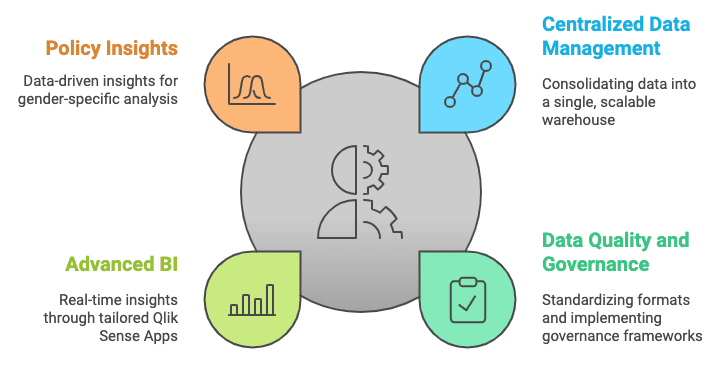
- Centralized Data Management: Consolidate data from legacy systems into a single, accessible, and scalable data warehouse.
- Enhanced Data Quality and Governance: Standardize data formats and implement governance frameworks for improved accuracy and compliance.
- Advanced Business Intelligence (BI): Enable real-time insights and advanced analytics through Qlik Sense dashboards tailored to diverse reporting needs.
- Policy Insights: Support data-driven policymaking with insights, including gender-specific analysis of grant allocation and reimbursements.
Scope
The project focused on the following areas:
- Data Integration and Centralization:
- Migration of data from multiple legacy systems into a modern data warehouse.
- Implementation of automated ETL pipelines for consistent data updates.
- Data Warehouse Development:
- Creation of a structured, scalable data warehouse for grants, reimbursements, and demographic data.
- Business Intelligence and Dashboards:
- Development of Qlik Sense dashboards covering:
- Grants distribution by type, region, and demographic (e.g., gender).
- Reimbursement processing and timelines.
- Policy-focused analytics, including trends in grant allocation based on gender.
- Financial overviews and compliance reporting.
- Data Governance:
- Establishment of rules and processes to ensure data quality, privacy, and regulatory compliance.
Challenges
- Legacy System Complexity:
- Integrating data from outdated systems with inconsistent formats and data quality issues.
- Data Accessibility:
- Providing stakeholders with easy access to real-time data and visualizations.
- Analytical Depth:
- Meeting the need for granular insights, such as demographic breakdowns, while maintaining usability.
- Scalability:
- Designing a solution that can adapt to future data sources and reporting requirements.
Solution
- Data Integration and Warehouse Development:
- Migrated historical data from legacy systems into a centralized data warehouse using modern ETL tools.
- Established automated data pipelines to ensure real-time updates and consistency.
- Advanced Data Modeling:
- Structured data to support flexible, multi-dimensional analysis in Qlik Sense.
- Ensured datasets were optimized for performance, including complex calculations like gender-based breakdowns.
- Qlik Sense Dashboards:
- Developed interactive, user-friendly dashboards:
- Grants Dashboard: Overview of grants issued, segmented by type, region, and demographic indicators.
- Reimbursement Dashboard: Tracking reimbursement processes, including time to disbursement and total amounts by category.
- Policy Insights Dashboard: Gender-based analysis of grants, identifying trends and informing policy decisions.
- Financial Reporting Dashboard: Comprehensive financial overviews for internal and external audits.
- Governance and Security:
- Implemented robust access controls to ensure data privacy and compliance with Icelandic data regulations.
- Established data validation and monitoring processes to maintain high data quality.
Delivery
- Phase 1: Data Discovery and Planning:
- Conducted a thorough audit of legacy systems and stakeholder requirements.
- Designed a data integration and warehouse architecture.
- Phase 2: Data Warehouse Implementation:
- Migrated and integrated data into the warehouse.
- Built automated ETL processes for continuous updates.
- Phase 3: Qlik Sense Apps :
- Designed and deployed dashboards & data apps tailored to various stakeholder needs.
- Conducted user testing and incorporated feedback.
- Phase 4: Training and Support :
- Delivered training sessions to users on accessing and interpreting dashboards.
- Provided ongoing support for system and dashboard enhancements.
Impact
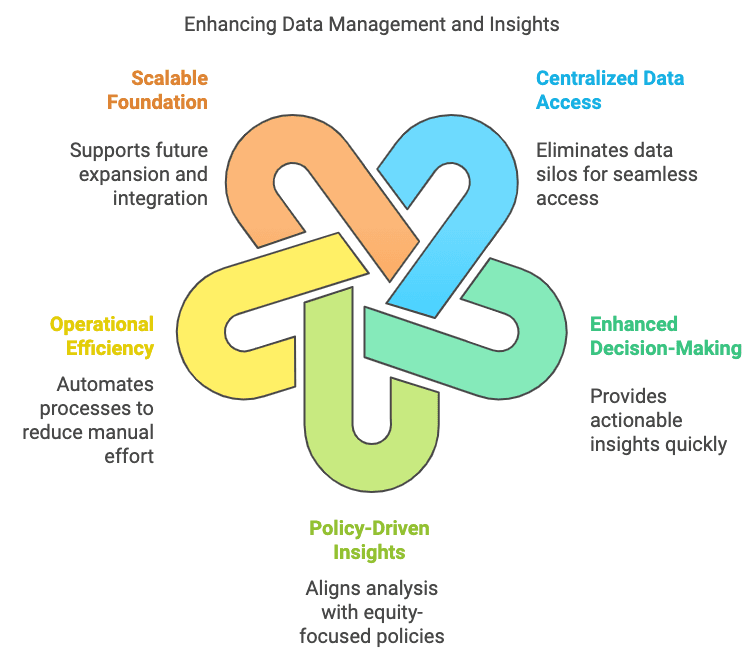
- Centralized Data Access:
- Eliminated data silos, enabling seamless access to consolidated, real-time data.
- Enhanced Decision-Making:
- Qlik Sense dashboards provided actionable insights, reducing report generation time from days to minutes.
- Policy-Driven Insights:
- Gender-based analysis of grants empowered the entity to align with equity-focused policies and transparency requirements.
- Operational Efficiency:
- Automated data pipelines minimized manual efforts and improved data reliability.
- Scalable Foundation:
- A modern, scalable data architecture that supports future expansion and integration of additional data sources.
This Data Foundations project has transformed how the government entity manages and analyzes data, providing them with the tools needed to improve transparency, drive equitable policies, and ensure efficient allocation of public resources. The integration of Qlik Sense Data apps has further solidified their ability to deliver real-time, impactful insights to stakeholders and decision-makers.