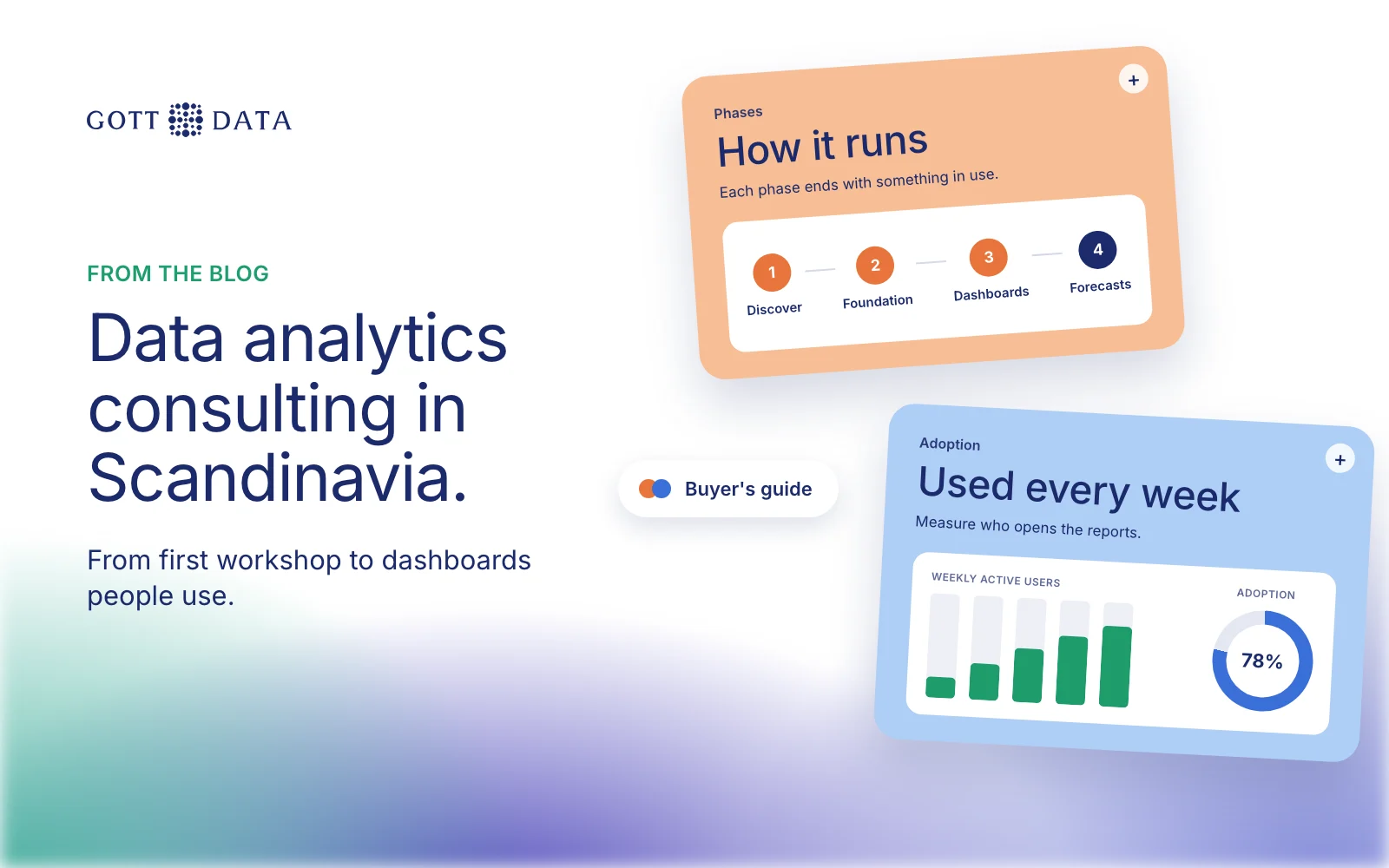
Data analytics consulting in Scandinavia is usually bought in phases: a short discovery, a data foundation, dashboards people use, and only then forecasts or machine learning. Buyers who skip ahead tend to pay twice. This guide covers how the phases work, which stack questions to settle early, how contracts are usually shaped, and a simple brief you can send to suppliers.
What are the usual phases?
Most good analytics projects follow the same order. Each phase should end with something in use, not just a document.
- Discovery. A few weeks of mapping sources, owners and the questions people actually ask. The output is a short plan: which reports to rebuild first and which definitions need agreeing.
- Data foundation. Pipelines that load your systems into one warehouse, with one set of rules for dates, currency, customers and products. Checks run on every load.
- Dashboards. A small set of reports on that foundation, built with the people who will use them. Track who opens them each week. If nobody does, fix the report before building the next one.
- Advanced analytics. Forecasts, recommendations or anomaly detection, built on data you already trust.
The last phase gets the most attention in sales meetings. It depends entirely on the first two.
Which stack questions should you settle early?
Three questions shape everything after them.
Where will the data live? The GDPR applies across the European Economic Area, and personal data that leaves the EEA needs extra safeguards, such as adequacy decisions or standard contractual clauses. Keeping the warehouse, backups and BI service in the EEA is usually the simplest route. Ask every supplier where each component is hosted.
Microsoft, Qlik or open source? If your company already runs on Microsoft 365, Microsoft Fabric is an obvious candidate. It is a SaaS analytics platform with Data Factory for integration, a data warehouse, and Power BI for reports, all over a shared data lake called OneLake. Qlik Sense suits teams that want to explore data freely across many tables. Open-source tools give the most control, but you need people to run them. We compare the two main BI tools in Qlik Sense vs Power BI.
Who maintains it? Decide early whether your team, the supplier or both will own the pipelines after launch. That choice affects tool choice, documentation and training.
How are contracts usually priced?
Two models are common, and many projects use both.
- Fixed scope, fixed price works well for discovery and for a clearly bounded first phase. You know the cost up front. The risk is that scope is defined before anyone understands the data.
- Time and materials, or a monthly retainer, suits ongoing work: new sources, new reports, support. It is flexible, but needs a clear backlog and regular reviews.
A sensible pattern is a fixed-price discovery, then a fixed or capped first phase, then a retainer for what follows. Ask for effort estimates per phase, not a single number for everything.
What should you put in a brief?
A short brief gets better answers than a long one. Cover these points:
- Background. What the organisation does, and which decisions are slow today.
- Systems. Each source system, roughly how much data, and who owns it.
- Questions. The five reports or questions that matter most.
- Constraints. Hosting requirements, existing licences, security rules, languages.
- Ownership. Who will run the solution after launch.
- Timeline. When you need the first report in use.
- What to send back. Approach per phase, team, effort estimates, two relevant case studies, and how handover works.
Ask each supplier to explain one past project in detail. How they describe the messy parts tells you more than the slides.
How do you judge the answers?
Look for suppliers who:
- Ask about your definitions before your dashboards.
- Propose a small first phase with a report in use within weeks.
- Explain their data quality checks without being asked.
- Write documentation your own team could follow.
- Are open about hosting and who can access your data.
We work this way from Reykjavík. For example, our TourDesk project started with a governed data foundation and incremental loads before any dashboard was built. For KMÍ, working with Móholt, a central warehouse came first and report generation went from days to minutes.
If you are writing a brief, our approach explains how we run projects, and you can send us what you have.