There is no single best firm among the data consultancies in the Nordics. There are good firms of very different sizes, from IT groups that work across many countries to data teams of a few dozen people in one city. The right choice depends on the size of your project, the tools you use and who you want to work with day to day. This guide names several firms across the region, explains what directory rankings measure, and gives you a checklist. We are Gott Data, a small data and software company in Reykjavík, so we are one of the options too. What we say about other firms comes from their own websites.
What kinds of firms are there?
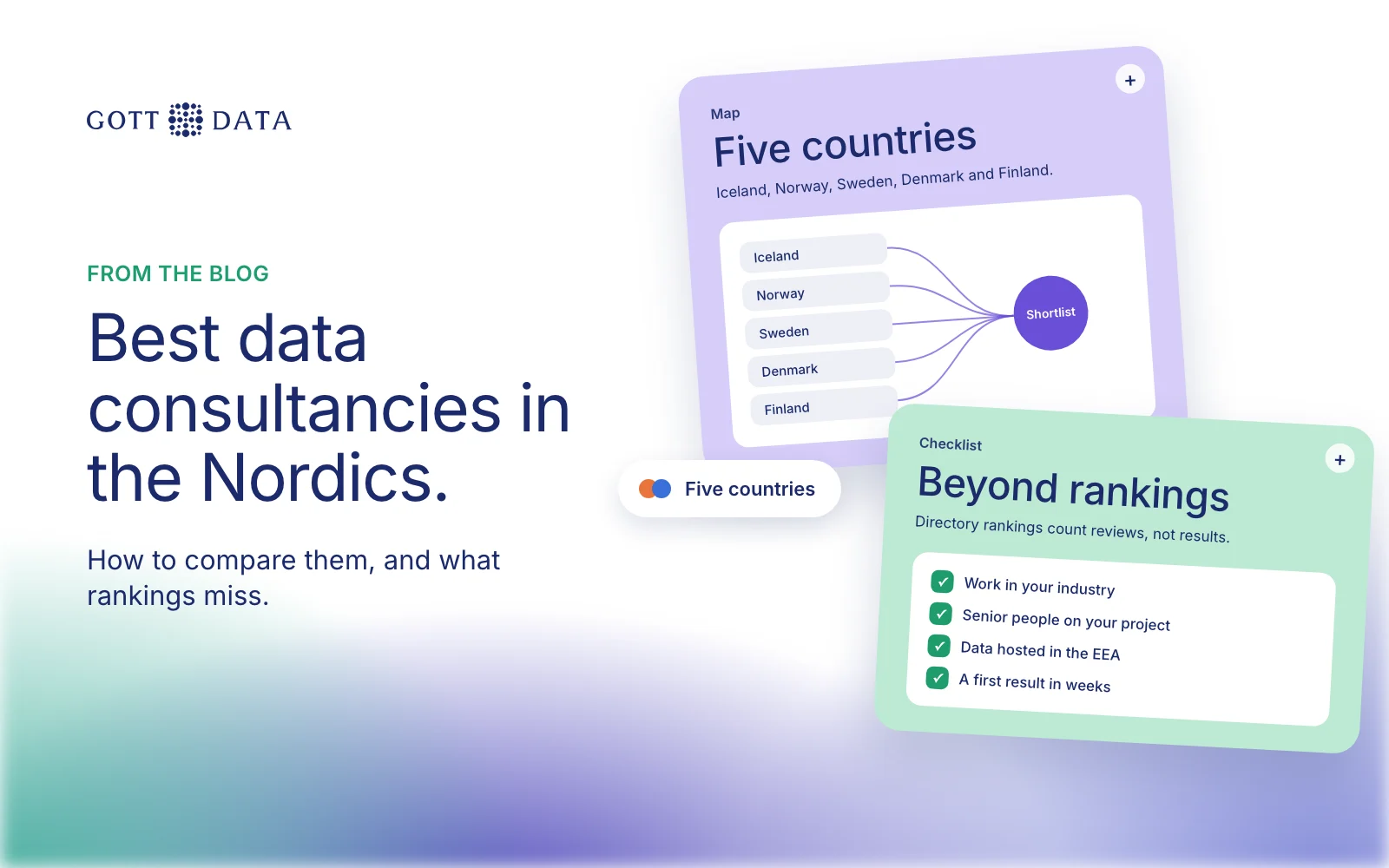
Across Iceland, Norway, Sweden, Denmark and Finland, data firms tend to fall into four groups.
- Large Nordic IT groups. Many services, many industries, offices in several countries.
- Digital consultancies with data and AI practices. Software, design and data under one roof.
- Data, BI and AI specialists. Warehouses, reporting and models are the whole business.
- Small studios. One team that handles the data and builds the software around it.
Large firms can staff big programmes and run systems for years. Specialists and studios tend to mean fewer layers between you and the people doing the work.
Which firms do data work in the region?
Here are examples from each country we looked at. Each description is based on the firm's own site.
- Tieto lists AI and data, software development, cloud, and design and consulting among its services. It has regional sites for Sweden, Norway, Denmark and Finland, and case studies include a unified data foundation for a Finnish county.
- Solita calls itself a technology and consulting company that builds digital solutions, covering strategy, design, data, AI and software. It lists offices in eight countries, including Finland, Sweden and Denmark, and partners such as Databricks, dbt and Snowflake.
- Knowit is a digital transformation consultancy, with Knowit AB based in Stockholm. Its cases include a data platform in Azure with Databricks for Skyss, and several AI projects.
- twoday describes itself as an AI and advanced engineering company, with services in data, cloud, engineering, applications and applied AI.
- Bouvet is a Nordic consulting company that designs, develops and manages IT solutions. It offers data and AI work, from strategy to working solutions, with projects across Norway for clients such as Equinor.
- Random Forest is a data consultancy with offices in Stockholm, Gothenburg, Malmö and Aarhus. It covers data management, business intelligence, and advanced analytics and AI.
- Inspari, part of valantic, is a Danish data and AI consultancy with offices in Lystrup and Kongens Lyngby. It builds data platforms and BI on tools such as Microsoft Fabric, Snowflake and Databricks.
- Gott Data, founded in Reykjavík in 2022, does data foundations and ETL, BI dashboards in Qlik Sense and Power BI, machine learning and bespoke software in one team.
The list is not complete, and the order means nothing. Use it to start a shortlist of three.
What do directory rankings miss?
Clutch, TechBehemoths, Sortlist and similar sites publish "top data companies" lists for each country. They are a fair way to find names. They are a weak way to judge quality.
Clutch's help pages say reviews are the most heavily weighted part of its score, alongside work experience and market presence. Rankings also differ from page to page, because each directory has its own formula. So a top spot mostly reflects how many recent reviews a firm has collected on that site and how complete its profile is. Many capable firms never ask clients to leave reviews there, so they rank low or not at all.
How should you compare a shortlist?
Score each firm from 1 to 5 on these points:
- Work in your industry. Ask for two case studies close to your problem, with a client you can call.
- Senior people on your project. Find out who will design the data model and who will write the code.
- Data hosted where you need it. Many Nordic buyers want data kept in the EEA. Ask where it will live.
- A first result in weeks. A small, priced first phase shows how a firm works before you commit more.
- You own the result. The warehouse, pipelines, reports and code should be yours to keep or hand over.
- Support after launch. Agree who watches the data loads and what a fix costs.
If two firms score the same, pick the one whose people you would rather talk to every week.
Where does a small studio fit?
A small studio makes sense when your project is focused and you want one team across data and software. Our own work is an example. For TourDesk, we joined hotel, vendor and booking data into one governed source of truth with Qlik Sense dashboards. For Original Buff in Spain, we built a model that flags machine failures before they happen. Both are on our TourDesk and Buff case study pages.
A large group is the better choice if you need many specialists at once, or one supplier for systems across several countries.
If you want to see how we run data projects, our approach page sets it out, and you can book a call to talk it through.