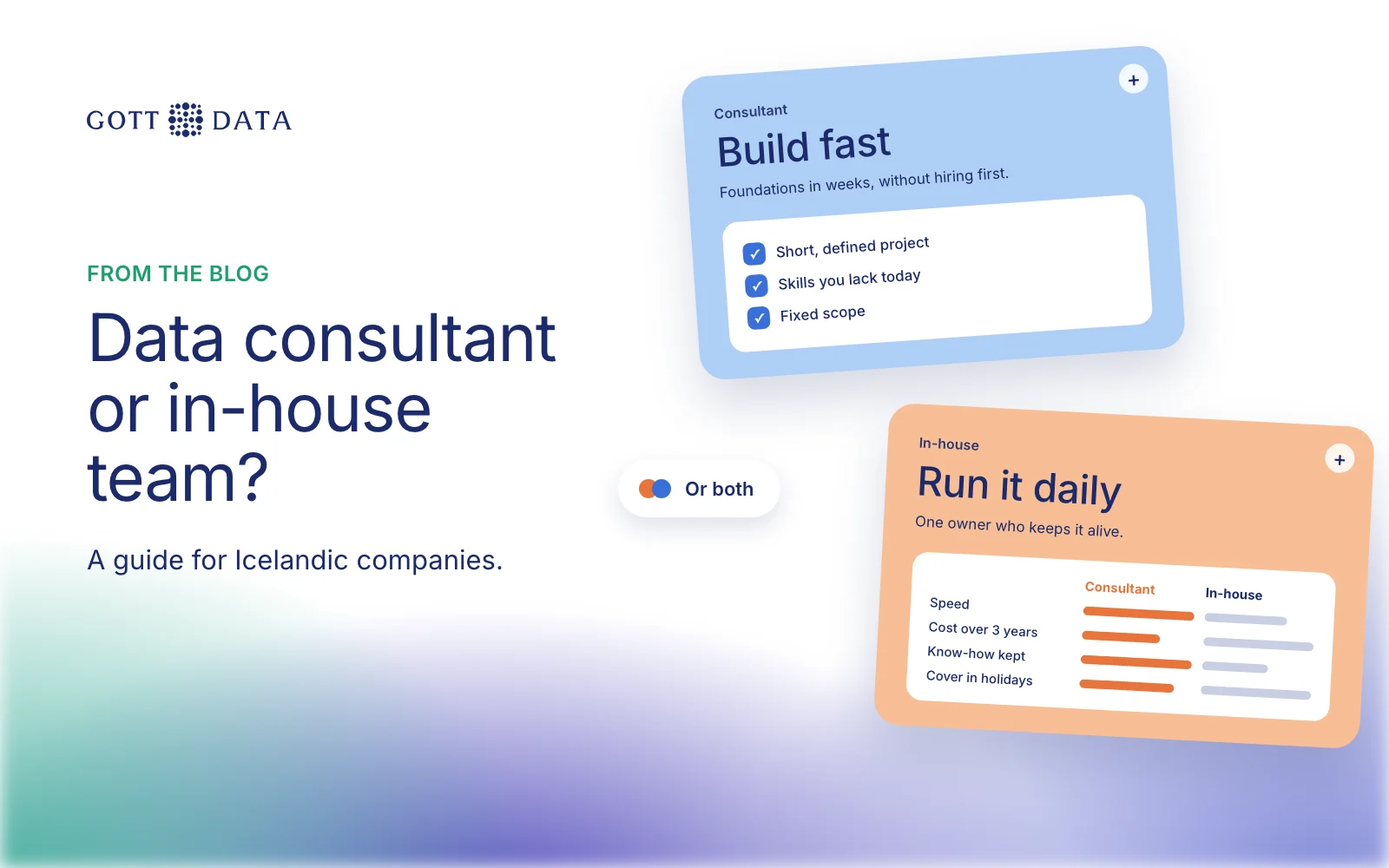
Should an Icelandic company hire a data consultant or build an in-house data team? For most small and mid-sized firms in Iceland, the answer is both, in order. A data consultant builds the foundations quickly. One person inside the company then owns them day to day. This guide sets out when each option fits, and how to combine them.
What does each option give you?
A data consultant brings people who have built data warehouses, pipelines and dashboards many times before. You pay for a defined piece of work. The team can start in weeks, without a hiring round.
An in-house data team is people on your payroll who know your business, your systems and your history. They are there every day. They can answer a quick question in an afternoon, and they keep the know-how inside the company.
Neither is better in general. They solve different problems. A consultant is good at building something new. An internal owner is good at keeping it useful.
When should you hire a data consultant?
A consultant makes most sense when:
- The work has a clear start and end. For example, a first data warehouse, a move from spreadsheets to Power BI or Qlik Sense, or a single machine learning model.
- You need skills nobody on the team has. Data modelling, ETL, cloud set-up and model deployment are separate skills. A first project often needs all of them for a short time.
- You need results this quarter. Hiring takes time. A consultant can be working on your data while you are still writing a job advert.
- You are not yet sure what you need. A short project shows which reports people use and which roles you will need later.
Here is an example from our own work. For KMÍ, an Icelandic government entity, we built a central data warehouse and Qlik Sense dashboards for grants and reimbursements, working with Móholt. That is a defined build with a clear finish, the kind of project consultants are suited to. See the KMÍ case study.
When should you build an in-house team?
Hiring makes more sense when:
- Data work is daily and never ends. New questions arrive every week, and someone needs to answer them fast.
- The data is the product. If you sell analytics, pricing or recommendations, the people who build them are core staff.
- You need deep business knowledge. Some questions need years of context about customers, contracts and odd exceptions.
Plan for the size of the market, too. Iceland is a small country, so the number of experienced data engineers looking for work at any one time is small. One hire also means one point of failure. If that person is on holiday or leaves, nobody else may understand the pipelines. A team of one is fragile.
What does the hybrid look like?
The model we see work best for small and mid-sized firms is a split:
- The consultant builds the foundations. The warehouse, the pipelines, the data model and the first dashboards.
- One internal person is named as owner from day one. Often an analyst, a controller or someone in operations who already lives in the numbers.
- The owner learns while it is being built. They join reviews, agree the definitions and make changes with the consultant beside them.
- The consultant steps back. After launch, the consultant handles larger changes and stands in when the owner is away. The owner runs the reports.
This gives you speed at the start and know-how that stays in the company. It also means you hire later, when you know what the role really is.
A simple decision table
Use this as a starting point. If most of your answers fall in one column, start there.
| Question | Consultant | In-house | Hybrid |
|---|---|---|---|
| Is the work a defined project? | Yes | No, it is ongoing | Build first, run after |
| Do you have data skills today? | No | Yes, several people | One person, keen to learn |
| How soon do you need results? | This quarter | Can wait for hiring | This quarter |
| Is data your core product? | No | Yes | Partly |
| Can you cover holidays and leavers? | Consultant covers | Need two or more people | Consultant backs up the owner |
What should you ask a data consultant?
If you decide to bring in outside help, ask these before you start:
- Who will own this after you leave? A good consultant plans the handover from the first week.
- Where will the code and data live? In your accounts, under your name.
- Will it run on tools we already pay for? A dashboard in your existing BI tool is easier to keep alive than a new platform.
- What does support look like after launch? Agree how changes are requested and paid for.
For TourDesk, we joined hotel, vendor, booking and car rental data into one governed source with automated pipelines and Qlik Sense dashboards. The aim was a foundation the business could keep using. See the TourDesk case study.
If you are weighing up a first data project or your first data hire, our analytics work shows how we build foundations, and you can book a short call to talk it through.