A good Databricks consulting partner is one whose status you can check, whose people hold current Databricks certifications, and who can show you a project like yours. This post explains what the partner tiers mean, the questions worth asking, and the signs that you may not need Databricks at all. To be clear from the start: we are not a Databricks partner. We build data warehouses and pipelines on other platforms, which is why we can be blunt about when Databricks fits.
What do the Databricks partner tiers mean?
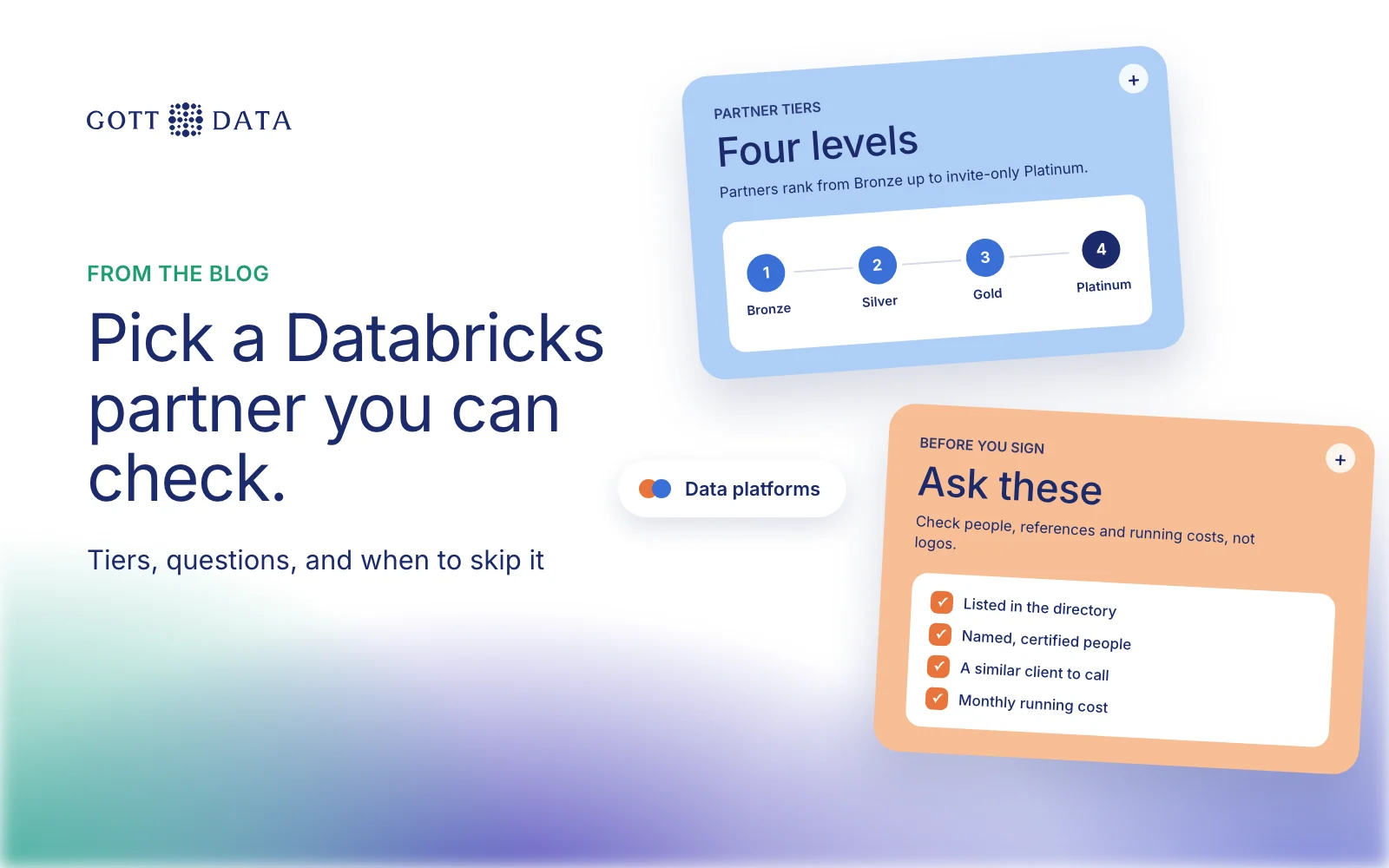
Databricks runs a partner programme with four tiers. As of November 2026, its partner programme page lists them from lowest to highest:
| Tier | What Databricks says it takes |
|---|---|
| Bronze | A signed agreement. The entry point for new partners. |
| Silver | Baseline performance, revenue generation and a certified team. |
| Gold | Proven practices, certified professionals, customer success stories and at least one Brickbuilder specialisation. |
| Platinum | Invite only, for strategic global partners, with multiple specialisations. |
Partners move up through a partner value score. Points come from things like registered use cases, joint customers, certified consultants and customer satisfaction surveys.
So a tier tells you something about volume and investment in the relationship with Databricks. It tells you less about whether a given team has solved your kind of problem. A Bronze partner may have one excellent engineer. A Platinum partner may staff your project with juniors.
How do you check a partner's status?
Don't rely on a logo or a badge on a website. Check it at the source:
- Look them up in the Databricks partner directory on databricks.com.
- Ask which tier they hold and when it was last confirmed.
- Ask for the certifications of the people who will do the work, not the company total. Databricks offers associate certifications such as Data Engineer, Data Analyst and ML Engineer, and professional ones for Data Engineer and ML Engineer.
- Ask about Brickbuilder solutions if they claim an industry speciality. These are packaged partner solutions that Databricks features on its site.
If a firm says it is a partner but doesn't appear in the directory, ask why before you sign anything.
Which questions should you ask before signing?
Tier and certificates are the entry ticket. These questions separate good partners from the rest:
- Who exactly will work on our project? Ask for names and CVs, and whether they stay for the whole engagement.
- Can we speak to a client with a similar setup? Similar size, similar sources, similar cloud.
- What will it cost us to run each month? A partner should estimate compute and storage as well as their own fees.
- How do you hand over? You want code in your repository, documentation, and training for your team.
- What would you not put on Databricks? A partner who has no answer to this is selling a platform, not solving a problem.
- How do you handle data protection? For European companies, ask where data and backups are stored and who can access them.
When might you not need Databricks?
Databricks is built for large data volumes, data engineering at scale, and machine learning on the same data. Plenty of companies have those needs. Many small and mid-sized ones don't.
You may be better served by something simpler if:
- Your data fits comfortably in a single Postgres or SQL Server database.
- Your main need is monthly and weekly reporting in Power BI or Qlik Sense.
- You have a handful of sources, such as accounting, CRM and a booking system.
- Nobody on your team will maintain Spark jobs or notebooks after the partner leaves.
- Machine learning is a future idea rather than a current project.
In those cases a well-designed warehouse with scheduled ETL and clear definitions usually costs less to build and run. You can move to a lakehouse later if volumes grow. Data lake vs data warehouse explains the difference.
What does a good first engagement look like?
Whoever you choose, start small. A sensible first phase:
- Pick one business question that matters, such as margin by product or demand by week.
- Connect the two or three sources that answer it.
- Agree the definitions in writing.
- Build the pipeline with data quality checks and a dashboard on top.
- Review the running cost after a month of real use.
That tells you more about a partner than any tier. It also tells you whether the platform suits your data.
If you're weighing Databricks against a simpler warehouse and want an independent view, our analytics work shows what we build, and you can tell us about your data.