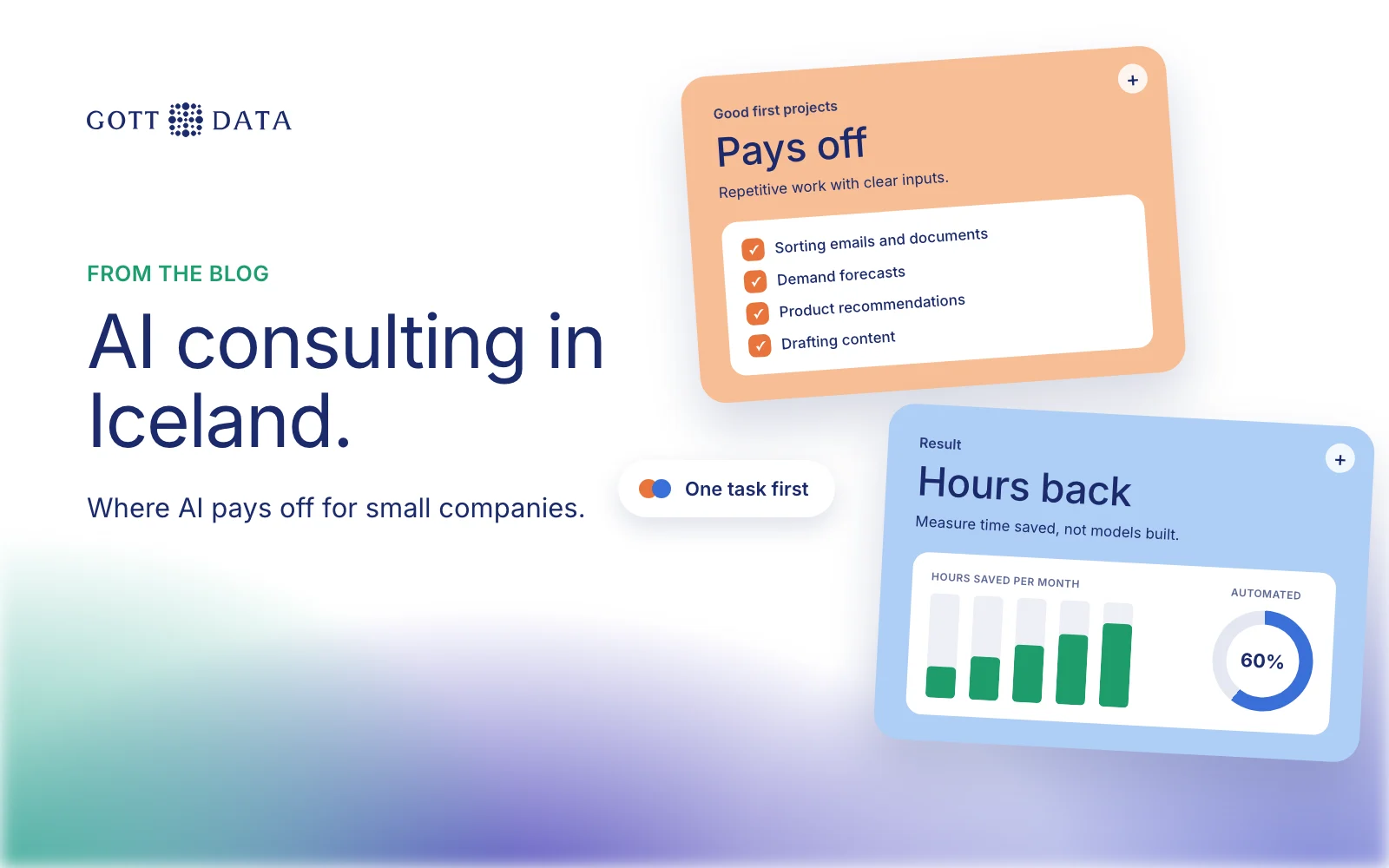
AI consulting in Iceland should start with one question: which task in your company is repetitive, has clear inputs and takes hours every week? That is where AI pays off for a small company. It is rarely a chatbot on the home page. It is usually sorting emails and documents, forecasting demand, recommending products or drafting routine content. This guide covers where AI works for Icelandic SMEs, where it doesn't, and what to check before you spend money.
Where does AI pay off for a small company?
The best first projects share three traits. The task repeats often. The inputs are already digital. And a person can check the output quickly. Four types fit that pattern well:
- Document and email handling. Reading invoices, orders or enquiries, pulling out the fields that matter and routing each one to the right person.
- Forecasting. Predicting demand, staffing or stock for the coming weeks from your own history.
- Recommendations. Putting the right product or plan in front of each customer or sales rep.
- Content. Drafting product texts, articles or reports that a person then edits and approves.
Measure the result in hours saved or errors avoided, not in models built. If you can't say how many hours a task takes today, measure that first.
What does this look like in practice?
Three projects we have shipped show the range.
For AstrolGuru, we built a content pipeline that runs every morning. It keeps a 20-day plan of topics, picks the most relevant one, writes an article with headings and FAQs, creates an image and publishes it. Nobody runs it by hand, and it saves about 60 hours of work a month.
For CorEnroll, working with CloudTech, we built recommendation models for an insurance enrolment platform. Sales reps had spent much of their time searching for the right product. The models suggest trending products in the rep's state, similar products to a search, and add-ons at checkout. They run behind an API, and dashboards compare recommendations with actual sales.
For Original Buff in Spain, we trained models on three years of machine data to flag failures before they happen. Every Monday the maintenance team gets a report of the machines most likely to fail, so they fix the critical ones first.
None of these replaced a team. Each one took a slow, repeated task off people's desks.
Where doesn't AI pay off?
Some projects look promising and then stall. Be careful when:
- The decision is rare. If you make it four times a year, a spreadsheet and a good conversation will do.
- Nobody can check the output. If a wrong answer is costly and hard to spot, keep a person in charge.
- The data doesn't exist yet. A forecasting model needs history. Two months of bookings is not enough.
- The problem is really a process problem. If three teams define "a sale" differently, AI will not fix it. Agreeing the definition will.
Is your data ready?
Most AI projects spend more time on data than on models. Before you start, check four things:
- Where the data lives, and whether you can export it or reach it through an API.
- How far back it goes, and whether the definitions changed along the way.
- Who owns each source and can answer questions about it.
- Whether personal data is involved, and on what legal basis you hold it.
If the answers are messy, a small data foundation comes first. Joining sources into one database pays off whether or not AI follows. Our analytics work explains how we build one.
Do AI models handle Icelandic?
Better than they did, but test before you rely on them. In 2023 the Icelandic language company Miðeind led a group of volunteers to improve GPT-4's Icelandic, as part of the government's work with OpenAI. Iceland Review reported that the model was much better than its predecessor but still made grammatical errors and produced "translationese".
Models have changed since then, so don't assume either way. Take 20 real Icelandic emails or documents from your own business and run them through the model you plan to use. Check the output with a native speaker. For customer-facing text, keep a person reviewing it.
What about the EU AI Act?
The EU AI Act sorts AI systems by risk. Most business uses, such as drafting content or forecasting stock, fall into the lower risk levels. Some uses are banned outright, and others, such as screening job applicants, carry strict duties. The EU has marked the Act as relevant to the EEA, so Icelandic companies should follow how it is taken into the EEA Agreement. Gott Data has also signed up to the EU AI Pact.
How should you start?
Pick one task. Measure how long it takes today. Check the data behind it. Then build a small version, test it on real work for a few weeks and decide on the numbers.
That is how our approach works on every project. If you have a task in mind, tell us about it.