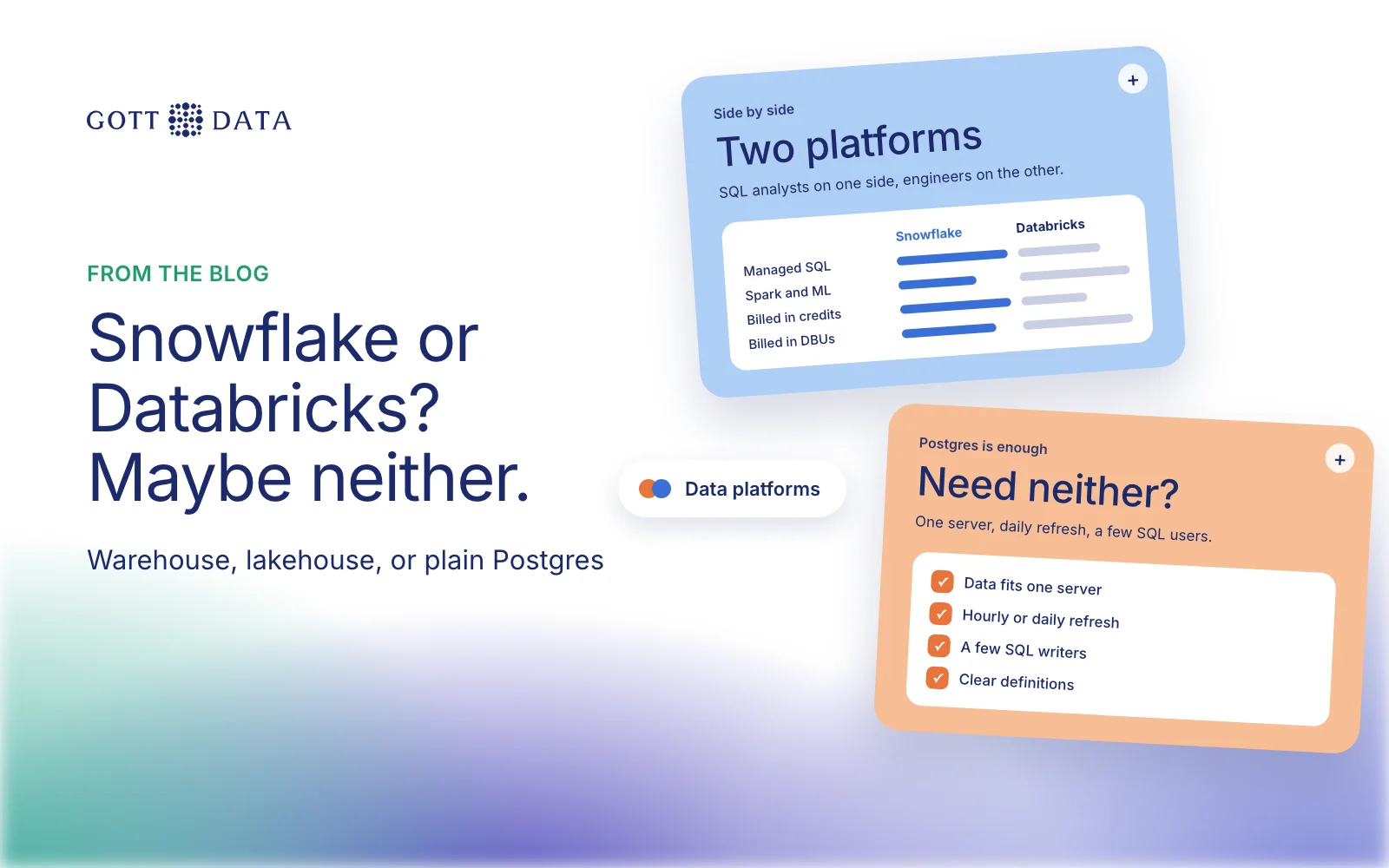
Snowflake vs Databricks, in plain words: Snowflake started as a cloud data warehouse for SQL analytics, and Databricks started as a Spark platform for data engineering and machine learning. Both now call themselves data platforms, and their features overlap a lot. For a business buyer the practical difference is who does the work. Snowflake suits SQL analysts who want a managed service. Databricks suits engineering teams who build pipelines and models. Many smaller companies need neither, and this post explains when.
We are not a partner of either vendor. This is an independent comparison based on their own documentation.
What is the difference between a warehouse and a lakehouse?
A data warehouse stores cleaned, structured data in tables, ready for SQL and reports. A data lake stores raw files of any kind, cheaply, in cloud storage. A lakehouse, in Databricks' words, is "a data management system that combines the benefits of data lakes and data warehouses".
Snowflake stores data in its own compressed, columnar format and runs queries on separate compute clusters it calls virtual warehouses. Each warehouse runs independently, so a heavy finance query doesn't slow down the sales dashboard. Snowflake handles maintenance, upgrades and tuning. You can't run it on your own servers.
Databricks runs inside your own cloud account. Data usually sits in your cloud storage in the open Delta Lake format, governed by Unity Catalog. You get Spark notebooks, SQL warehouses, streaming and machine learning in one place.
The line has blurred. Snowflake now offers Snowpark, with libraries for Python, Java and Scala, and Apache Iceberg tables that keep data in cloud storage you manage. Databricks offers SQL warehouses aimed at BI.
| Snowflake | Databricks | |
|---|---|---|
| Origins | Cloud data warehouse | Spark and data engineering |
| Main users | SQL analysts, BI teams | Data engineers, data scientists |
| Where it runs | Snowflake's service on AWS, Azure or Google Cloud | Your account on AWS, Azure or Google Cloud |
| Storage | Snowflake format, or Iceberg tables | Your cloud storage, Delta Lake |
| Pricing unit | Credits, plus storage and egress | DBUs, plus your cloud bill |
| Strongest at | Managed SQL analytics | Pipelines, streaming, machine learning |
How does Snowflake vs Databricks pricing work?
We won't quote rates. Both vary by region, edition and contract, and both publish current prices on their own sites. The models are clear, though.
Snowflake bills compute in credits. Virtual warehouses are billed per second while they run, with a 60-second minimum each time one starts. Storage is a flat rate per terabyte, based on the average stored each day. Bringing data in is free, but taking it out (egress) is charged.
Databricks bills in DBUs, which it calls "a normalized unit of processing power". Billing is per second and pay as you go, with discounts for committed use. Storage, networking and other cloud resources are billed separately by your cloud provider.
The practical point: with Snowflake you get one bill, but you need to watch how long warehouses stay running. With Databricks you get two bills, Databricks and your cloud provider, and need to watch both.
Which teams typically pick each?
Teams lean towards Snowflake when:
- Most work is SQL: reporting, finance, sales and marketing analytics.
- They want little infrastructure to manage.
- They prefer one bill to two.
Teams lean towards Databricks when:
- They build heavy pipelines from many raw sources, including streaming data.
- Machine learning is part of the product, not a side project.
- They want data to stay in their own cloud storage, in open formats.
Both connect to the common BI tools, including Power BI. If you are also weighing Microsoft's offer, Fabric is the third option many European companies compare.
When do you need neither?
More often than vendors suggest. A well-designed Postgres database, scheduled pipelines and a BI tool on top will serve many SMEs for years. That works when:
- Your data fits comfortably on one database server.
- Reports refresh hourly or daily, not every second.
- A handful of people write SQL, not a data team of twenty.
We build on Postgres ourselves. For KMÍ, an Icelandic government body, data from several legacy systems went into one central warehouse with Qlik Sense dashboards on top. Report generation went from days to minutes. It needed good modelling and clear definitions, not a lakehouse.
Move to Snowflake or Databricks when you outgrow that: data volumes that strain one server, many teams querying at once, or machine learning on large datasets. The data model and definitions you built carry over, so the earlier work is not wasted.
How do you decide?
Start from the questions, not the platform. Write down what the business needs to know each week, where that data lives and how fresh it must be. Then estimate volumes and the skills you have. The right platform usually becomes obvious.
If you want a second opinion before you sign a platform contract, see our analytics work or tell us about your data.