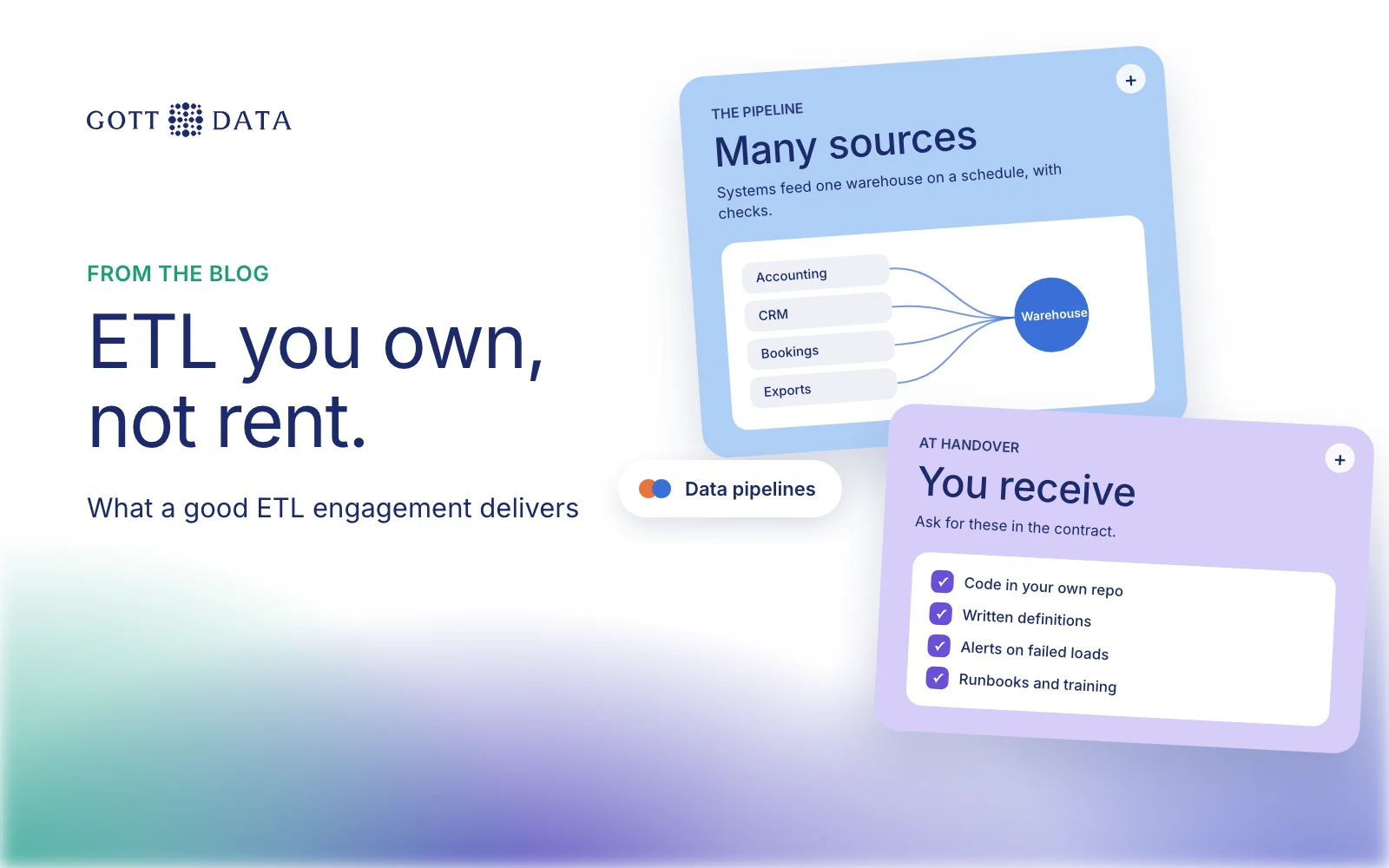
ETL consulting services cover everything needed to move data from your business systems into one place you can report from: mapping the sources, agreeing definitions, building the pipelines, checking the data and handing over something your team can run. ETL stands for extract, transform, load. This post lists what a good engagement includes, what you should receive at the end, and the things that make a project bigger or smaller.
What is an ETL service?
ETL is the process of combining data from many systems into a central store, usually a data warehouse. Data is extracted from each source, cleaned and reshaped, then loaded. A close variant, ELT, loads raw data first and transforms it inside the warehouse. AWS notes that ETL needs more definition up front, while ELT suits large, loosely structured data that is loaded often. Either can work for a mid-sized company.
An ETL service is the work of designing, building and running those pipelines for you. Some firms only build. Better ones also leave you able to run and change them.
What do ETL consulting services include?
A typical engagement has five parts:
- Source mapping. Every system that holds useful data, who owns it, and how to get data out: API, database access or file exports.
- Definitions. The rules that make numbers agree. Which date counts? Which currency? What is an active customer? These are written down and approved by the business, not decided by the developer.
- Pipeline build. Extraction on a schedule, transformation into one shape, and incremental loading, so only new or changed records move after the first full load.
- Data quality checks. Row counts against the source, totals reconciled to accounting, alerts for missing days, duplicates and odd values.
- Monitoring and handover. Alerts that reach a named person, documentation, and training.
Reporting on top, in Power BI, Qlik Sense or a custom dashboard, is often part of the same project. It is where people first see whether the definitions are right.
What should you receive at the end?
Ask for these in the contract, so there is no doubt later:
- The pipelines, running on a schedule, in your own cloud account or repository.
- A definitions document listing each business rule and where it is applied.
- A source catalogue with owners, refresh times and known limits.
- Monitoring that alerts on failed loads and failed checks.
- Runbooks for common problems: a source changes its export, a load fails overnight, a new field appears.
- Training for the people who will maintain it.
If a supplier keeps the code on its own servers, you are renting reports, not owning a data foundation.
What drives the cost of an ETL project?
We won't quote a figure here, because the range is wide. These are the factors that move it:
| Factor | Smaller job | Bigger job |
|---|---|---|
| Number of sources | Two or three | Ten or more |
| Access to data | Clean API or database | Manual exports, scraped portals |
| Legacy systems | Recent, documented | Old, undocumented, years of history |
| Definitions | Agreed already | Disputed between teams |
| Refresh needs | Nightly | Near real time |
| Data protection | No personal data | Sensitive data, strict access rules |
The biggest hidden cost is usually definitions. Building a pipeline is quick once people agree what revenue means. Getting that agreement can take longer than the code.
What does this look like in practice?
For TourDesk, which connects hotels with tours and excursions, data from hotels, vendors, suppliers, car rentals and restaurants sat in separate systems. We built automated ETL pipelines with Qlik Sense Data Integration, with routines to clean and transform the data into one consistent format. Incremental loads keep reporting near real time, and governance covers data quality and GDPR. The project continues with ongoing improvements.
For KMÍ, an Icelandic government body that manages grants and reimbursements, working with Móholt, the project started with an audit of legacy systems. Historical data was migrated into a central warehouse, and automated ETL keeps it current. Data validation and monitoring were built in, and Qlik Sense dashboards sit on top. Report generation went from days to minutes.
How do you choose a supplier?
A few questions tell you most of what you need:
- Who owns the code and the cloud account at the end?
- How will we know when a load fails, and who is told?
- Can you show a definitions document from a past project?
- What happens when a source system changes?
- Which source would you connect first, and why?
A good answer to the last one names the source that feeds your most important report. Usable numbers in the first month beat every source at once.
If you want your systems feeding one trusted set of numbers, our analytics work shows how we build data foundations, and you can tell us which systems you use.