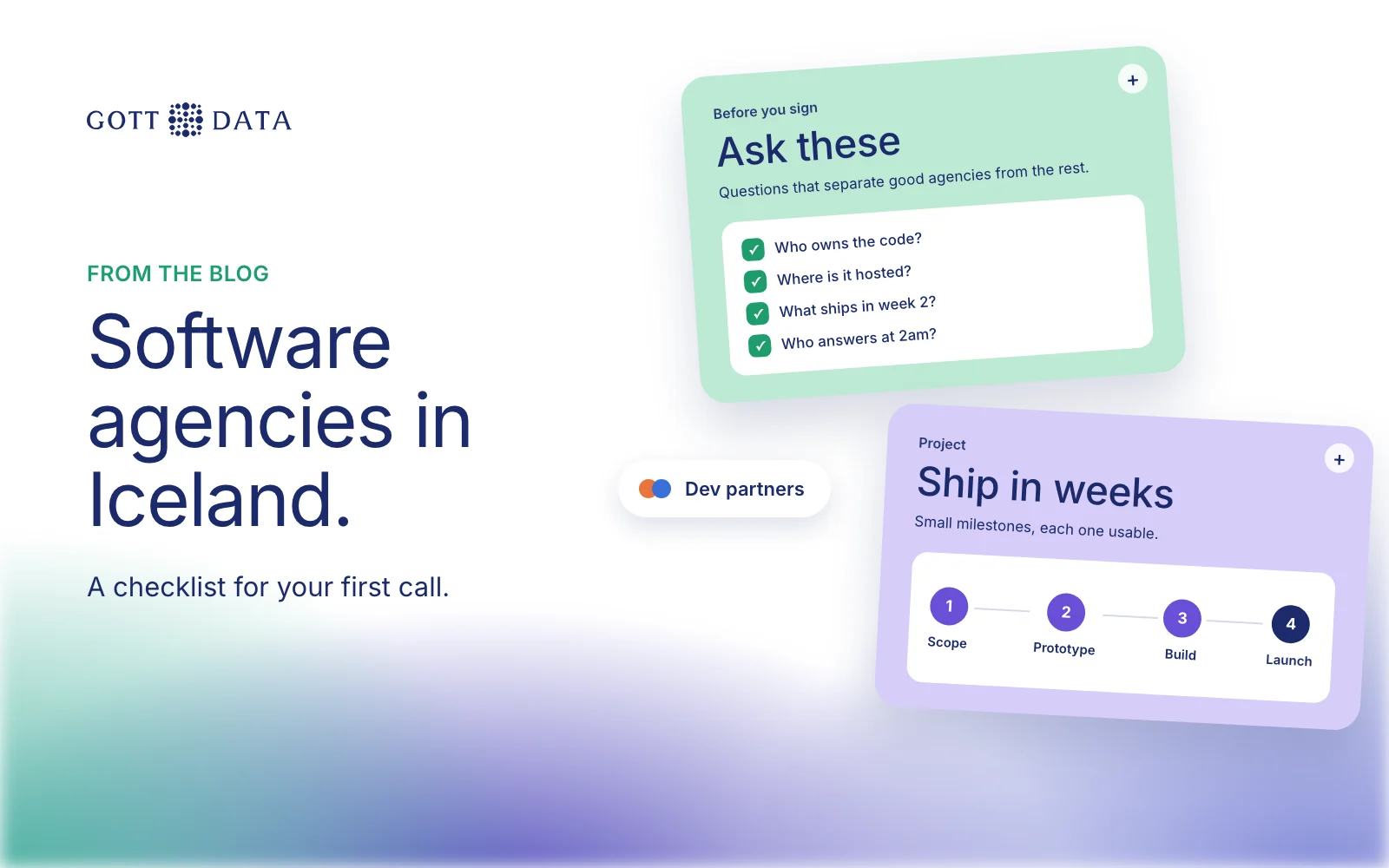
Hiring a software development agency in Iceland comes down to a handful of questions you can ask on the first call. Who will build it? How is the work priced? Who owns the code? Where does the data live? What will you see in the first two weeks? This checklist covers each one, with examples from projects we have shipped.
What kinds of agencies are there?
Most agencies you will meet fall into one of three groups:
- Design and web studios. Strong on brand, websites and marketing pages. Less often set up for complex back ends, data or long-running systems.
- Product and software teams. They build web apps, internal tools and SaaS products, and they look after them after launch.
- Data and software teams. They build the application and the data behind it: the database, the pipelines, the reports and any machine learning.
None of these is better in general. The right one depends on what you need. If your project is a booking system that also has to feed a revenue dashboard, a team that does both saves you a handover between two suppliers.
What should you ask on the first call?
A short list of questions tells you a lot. Good agencies answer them plainly.
- Who will do the work? Ask to meet the people who will write the code, as well as the person selling it.
- What have you built that looks like this? Ask for a live product or a case study, and what went wrong on it.
- What will I see in week two? A good answer names something you can click, not a document.
- How do you handle changes? Every project changes. You want a clear process, not a surprise invoice.
- What happens after launch? Ask who fixes bugs, how fast, and how that is paid for.
- Can I take the work elsewhere? If the answer is vague, treat it as a warning.
Fixed price or time and materials?
These are the two common pricing models. Each suits a different kind of project.
Fixed price works when the scope is small and clear. You know the cost up front. The trade-off is that changes need a new quote, and the agency will add a margin for risk.
Time and materials means you pay for the time spent, usually with a monthly cap or a budget per phase. It suits projects where you will learn as you go. The trade-off is that you need to watch progress closely.
A common middle ground is to fix the price of a short first phase, such as a prototype or a discovery sprint, then move to time and materials once both sides understand the work.
Who owns the code and the data?
Settle this in the contract before any work starts. Check three things:
- Code ownership. The contract should say the code and design belong to you once paid for. The code should live in a repository you control.
- Accounts and hosting. Cloud, domain and app store accounts should be in your company's name, with the agency added as a user.
- Personal data. If the agency handles personal data for you, GDPR requires a written processor agreement. Under Article 28, it must cover security, any subcontractors, and deleting or returning the data when the work ends.
Where should it be hosted?
Iceland is in the European Economic Area, and EU data protection rules apply across the EEA. Keeping personal data on servers in the EEA is the simplest way to stay inside those rules. If data has to leave the EEA, for example to a cloud service based elsewhere, extra safeguards such as standard contractual clauses are needed.
Ask the agency which region your database and backups will sit in, and which outside services will see your data. A good team can answer in one line per service.
How long should it take?
It depends on the scope, but you should see working software early and often. Some examples from our own work:
- PitPro was a vibe-coded MVP. We turned it into enterprise-ready SaaS in three weeks, with row-level security, rate-limited AI and a normalised schema. See the PitPro case study.
- Sleipnir is a rental system for car fleets, built end to end: inventory, role-based access, dynamic pricing and multi-step booking. See Sleipnir.
- The Sierra Leone investor campaign for the Ministry of Tourism, under the World Bank SLEDP project, included the website, outreach to 40,000 investors and a live government webinar. See the campaign.
- Our own website was designed and built in-house in a matter of weeks. See the Gott Data website.
The pattern is the same each time. Agree a small first milestone, ship it, use it, then plan the next one. If an agency proposes six months before you see anything, ask what you can have in four weeks.
A short checklist to take with you
Before you sign, make sure you can tick each of these:
- You have met the people who will build it.
- The first milestone is small and has a date.
- The pricing model and how changes are handled are written down.
- You own the code, the repository and the accounts.
- A processor agreement is in place if personal data is involved.
- You know where the data is hosted.
- Support after launch is agreed.
If you are planning a new system or want help with one that is struggling, our software work shows how we build, and you can tell us about your project.