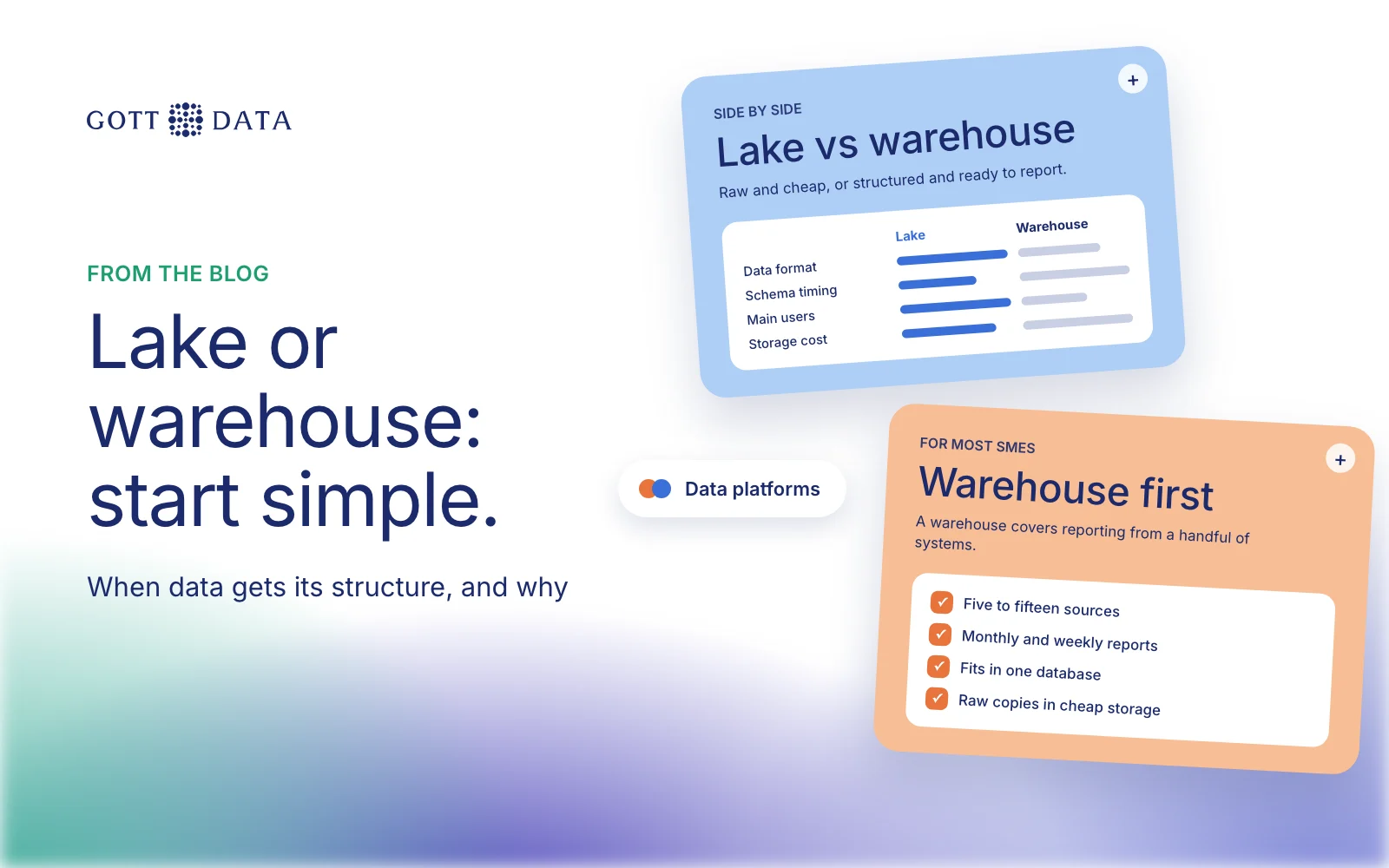
Data lake vs data warehouse is a question of when you give data its structure. A data warehouse stores cleaned, structured data that is ready for reporting. A data lake stores raw data in any format, cheaply, and you shape it when you need it. A lakehouse tries to give you both on one copy of the data. For most mid-sized companies whose main need is reliable reporting, a well-built warehouse is enough. This post explains the three, plus data marts and plain databases, and how to choose.
What is the difference between a data lake and a data warehouse?
The vendors who sell these systems define them clearly. AWS calls a data warehouse "a central repository of preprocessed data for analytics and business intelligence". Databricks calls it "a structured, SQL-optimized system for business intelligence."
A data lake, in Databricks' words, is "a low-cost storage system for raw data in any format." AWS adds that you can "store data first and process it later on."
The practical difference is schema. In a warehouse, you decide the tables and rules before data goes in, often called schema-on-write. In a lake, files land as they are and structure is applied when someone reads them, called schema-on-read.
| Data warehouse | Data lake | |
|---|---|---|
| Data stored | Structured, cleaned | Raw, any format: tables, logs, images, documents |
| Structure | Defined before loading | Applied when read |
| Typical loading | ETL, transform then load | ELT, load then transform |
| Best for | Reports, dashboards, finance | Large volumes, data science, unstructured data |
| Main users | Analysts, managers | Data engineers, data scientists |
| Main risk | Rigid if needs change fast | Turns into a swamp without governance |
Databricks itself notes that lakes without governance and transaction support can suffer from poor data quality and reliability.
What is a data lakehouse?
Databricks describes the lakehouse as an open architecture that combines the flexibility, cost and scale of data lakes with the data management and transaction features of a warehouse. The aim is for BI and machine learning to run on the same data, without copying it between a lake and a warehouse.
Open table formats such as Delta Lake make this possible by adding transactions and versioning on top of files in cheap storage. Similar ideas now appear across several vendors.
A lakehouse makes most sense when you have large data volumes, a mix of structured and unstructured data, and real machine learning work on that data.
Where do data marts and databases fit?
A database such as Postgres or SQL Server runs your applications: orders, bookings, customers. It is built for many small reads and writes, not for heavy reporting across years of history.
A data mart, per AWS, is "a data warehouse that serves the needs of a specific business unit", such as finance or sales. It is smaller and focused on one subject. Many companies build marts as views on top of one warehouse, so each team gets tables shaped for its questions.
AWS also notes that most large organisations combine all three, often loading data into a lake first, then into warehouses and marts.
What does a mid-sized company actually need?
Start with your questions, not the architecture. If they look like these, a warehouse is the right first step:
- Revenue, margin and costs by month, product, channel or region.
- Five to fifteen sources: accounting, CRM, a booking or order system, payroll, a few spreadsheets.
- Data volumes that fit comfortably in a single Postgres or cloud warehouse.
- Dashboards in Power BI, Qlik Sense or a custom app.
A lake or lakehouse becomes worth it when some of these are true:
- You collect large volumes of event, sensor or log data.
- You need to keep raw files, documents or images for later analysis.
- You train machine learning models on years of detailed history.
- You have engineers to run it after the build.
Many SMEs end up with a small version of both. Raw extracts are kept in cheap object storage as a safety copy. The cleaned, modelled data sits in the warehouse where reports read it. That gives you a way back to the raw data without the cost of a full lake platform.
How do our projects fit this?
Our data work is mostly warehouse-first. For KMÍ, working with Móholt, data from several legacy systems went into a central warehouse with automated ETL and Qlik Sense dashboards on top. For TourDesk, hotels, vendors, bookings and car rentals were joined into one governed source of truth, with incremental loads for near real-time reporting.
Neither needed a lake to answer its main questions. Both can add one later if the data grows in that direction.
If you're deciding between a lake, a warehouse or a lakehouse, our analytics work shows how we build data foundations, and you can tell us about your data.