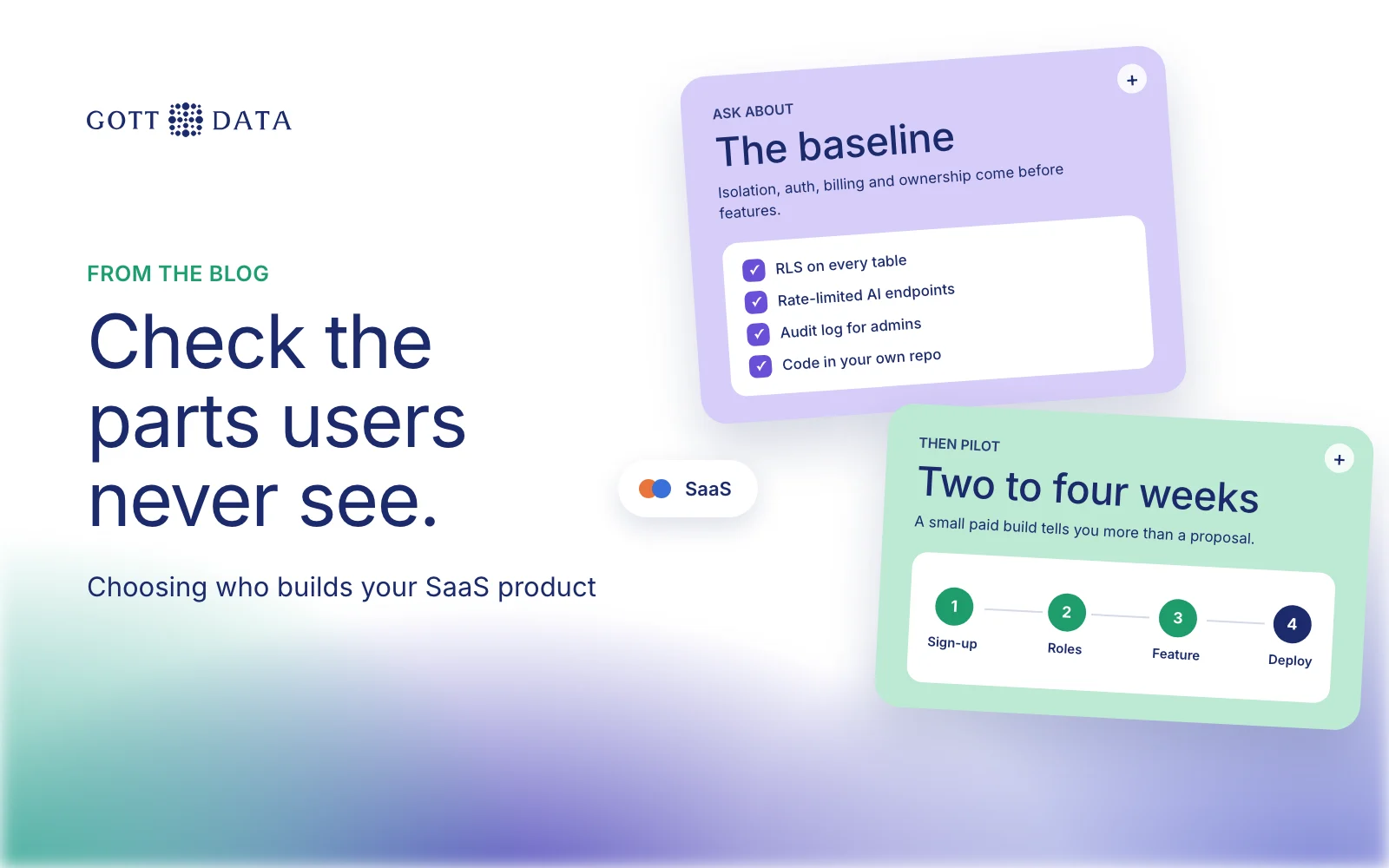
Choosing a SaaS development company is mostly about checking the parts users never see: how customers' data is kept apart, how login and billing work, what the security baseline is, and who owns the code. A polished demo tells you little. This post lists what to ask about each part, and how to test a supplier with a small paid pilot before you commit.
What makes SaaS different from a normal web app?
A SaaS product serves many customers from one system. That brings a few problems a single-company app doesn't have:
- Multi-tenancy. Customer A must never see customer B's data, even through a bug.
- Accounts and roles. Each customer has its own users, with admins, members and often read-only seats.
- Billing. Plans, trials, upgrades, failed payments and usage limits.
- Operations. Someone has to see which jobs failed, for which customer, and fix them safely.
A good SaaS development company has solved each of these before and can show you how.
How should customer data be kept apart?
There are three common designs: a separate database per customer, a separate schema per customer, or shared tables with a tenant ID on every row. Shared tables are the most common for early products, and they are safe only if isolation is enforced in the database, not just in application code.
In Postgres, the tool for this is row-level security (RLS). Supabase describes RLS as authorisation rules that run inside the database, applied every time a table is accessed. Its documentation warns that a table in an exposed schema without RLS is readable and writable by any role with a grant on it. Ask a supplier:
- Is RLS enabled on every table that holds customer data?
- How are the policies tested, including the case where a user tries another tenant's ID?
- Which operations run with elevated privileges, and where are those keys kept?
What about auth, billing and AI costs?
Auth. Use an established provider rather than custom password code. Ask how sessions are stored, how admin access is separated from customer access, and whether SSO is possible later.
Billing. Plans and limits should live in your database, synced from a payment provider. The app checks what a customer is allowed to do on the server, not in the browser.
AI features. If the product calls a language model, every call costs money. Endpoints should require login, be rate limited per user, and log spend per customer. Otherwise one script can run up a large bill overnight.
What security baseline and ownership should you expect?
Ask which standard the supplier works to. The OWASP Application Security Verification Standard (ASVS), currently version 5.0.0, is a free list of security requirements for web applications. Even without a formal audit, a supplier should be able to say how their work maps to it.
The basics worth checking:
- All business logic and validation on the server.
- Input validated on every endpoint.
- Secrets kept out of the browser and the repository.
- Privileged admin actions recorded in an audit log.
- Backups that have been restored at least once.
- Data hosted in the EEA if you serve European customers.
Code ownership. The code should be yours. The contract should say the code, the database and every cloud account belong to you. Work happens in your repository from day one, so you can see progress and move to another supplier or an in-house team at any point. Ask for documentation and a written handover plan before you sign, not at the end.
What does this look like in our projects?
PitPro came to us as an AI-built MVP for car workshops. It had no row-level security, unauthenticated AI endpoints, a flat data model and business logic in the browser. Over three weeks we moved it to a normalised Postgres schema on Supabase, with RLS on every table, server-side validation, and rate limits on the AI endpoints to control abuse and cost.
Marketing OS turns listing photos into scheduled, branded video. It runs one queue per pipeline step, so each stage scales and fails on its own, with typed retries throughout. Its admin console uses role-based permissions and an append-only audit log for every privileged action.
Quantile is a chat-first analytics workbench that generates code. That code runs in an isolated sandbox rather than on the app server, and customer row data stays out of the model prompt.
How do you test a supplier before committing?
Run a short paid pilot with a clear finish line. For example: sign-up, a tenant with two roles, one core feature, RLS policies with tests, and deployment to your own cloud account. Two to four weeks is usually enough to judge code quality, communication and pace. It is a far better signal than a proposal.
If you're building a SaaS product or hardening an MVP, our software work shows how we build, our approach explains how we run projects, and you can tell us what you're building.