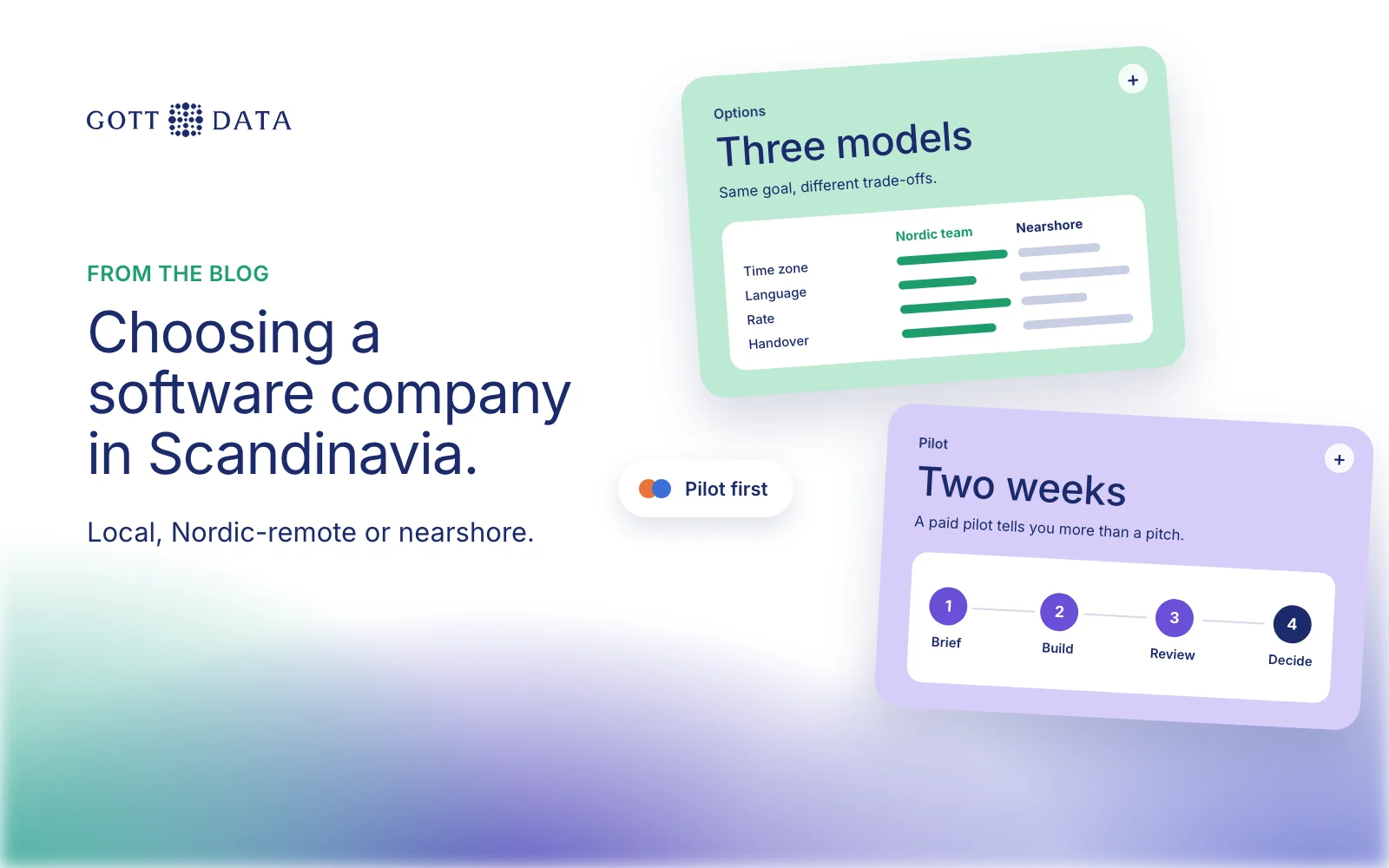
Choosing a software development company in Scandinavia starts with one decision: a local team, a Nordic team working remotely, or a nearshore team further away. After that, check four things. How many working hours do you share? How is personal data handled? Who owns the code? What security comes as standard? The cheapest way to test all four is a short paid pilot.
Local, Nordic-remote or nearshore?
Each model has a place. The trade-offs are mostly about contact, context and cost.
- Local team. Same city, same language, easy to meet. Best when the work needs many workshops with your staff, or when the project touches local rules and systems.
- Nordic team, working remotely. A team in another Nordic country that works with you online and visits when needed. You keep similar working culture, business norms and data rules, with a wider choice of teams.
- Nearshore team. A team in a lower-cost country that serves Nordic clients. Rates can be lower. The trade-off is more effort on briefs, reviews and handover, and sometimes more layers between you and the developers.
There is no single right answer. A clear, stable spec travels well to any model. A product that changes every week needs short feedback loops and people who can talk to your users.
Does the time zone matter?
Less than people think, but it still matters. What counts is how many working hours overlap, and whether someone is awake when something breaks.
Inside the Nordics the gaps are small. Iceland stays on UTC+0 all year and does not use daylight saving time. Norway uses Central European Time, UTC+1, and moves to UTC+2 in summer. So a team in Reykjavík is one hour behind Oslo in winter and two hours behind in summer. That still leaves most of the working day shared.
For any team you consider, ask two things:
- How many hours of your working day will they be online?
- Who responds to a production problem outside those hours, and how fast?
What about GDPR and IP ownership?
EU data protection rules apply across the European Economic Area. That covers Iceland and Norway as well as the EU members, so every Nordic country follows the same rules. If personal data leaves the EEA, extra safeguards are needed, such as standard contractual clauses.
So ask any software company:
- Where will the database and backups be hosted?
- Which outside services will process personal data?
- Will you sign a processor agreement? GDPR Article 28 requires one in writing when a supplier processes personal data for you.
For IP, the contract should state that the code, designs and data belong to you once paid for. The code should sit in a repository in your account. Cloud and domain accounts should be in your company's name.
What security baseline should you expect?
Security should be part of the first version, not a later phase. A sensible baseline for a web application includes:
- Access rules in the database, such as row-level security, so each user can only read their own rows.
- Roles and permissions for staff, with sensitive actions logged.
- Rate limits on logins, public APIs and any paid AI calls.
- A review or audit before launch, with the findings fixed and recorded.
On PitPro, we took a vibe-coded MVP to enterprise SaaS in three weeks. The work added row-level security, rate-limited AI and a normalised schema. See the PitPro case study. On Sleipnir, a rental system for car fleets, role-based access control was built in from the start, alongside inventory, dynamic pricing and multi-step booking. See Sleipnir.
How do you run a two-week paid pilot?
A pitch tells you how a company sells. A pilot tells you how it builds. Two weeks is long enough to see real work and short enough to stop if it is not a fit.
- Brief. Pick one small, real feature. Write down what done looks like.
- Build. The team works in your repository and shows progress at least twice a week.
- Review. Look at the code, the tests and the working feature. Ask how they would carry on.
- Decide. Continue, change the plan, or part ways. Either way, you keep the code.
Pay for the pilot. Free trials push teams to rush, and you learn less from a rushed pilot. Watch how they handle questions and bad news, as well as the demo.
Small teams can move fast when the scope is tight. We designed and built our own website in-house in a matter of weeks. The same habit of small, usable milestones is how we run client work.
A quick summary for your shortlist
- Pick the model that fits how often your requirements change.
- Check overlapping hours and out-of-hours support.
- Confirm EEA hosting, a processor agreement and code ownership.
- Ask what security ships in version one.
- Run a two-week paid pilot before a long contract.
If you are choosing a partner for a new product or a rescue job, our software work and how we work show what to expect, and you can tell us what you are building.